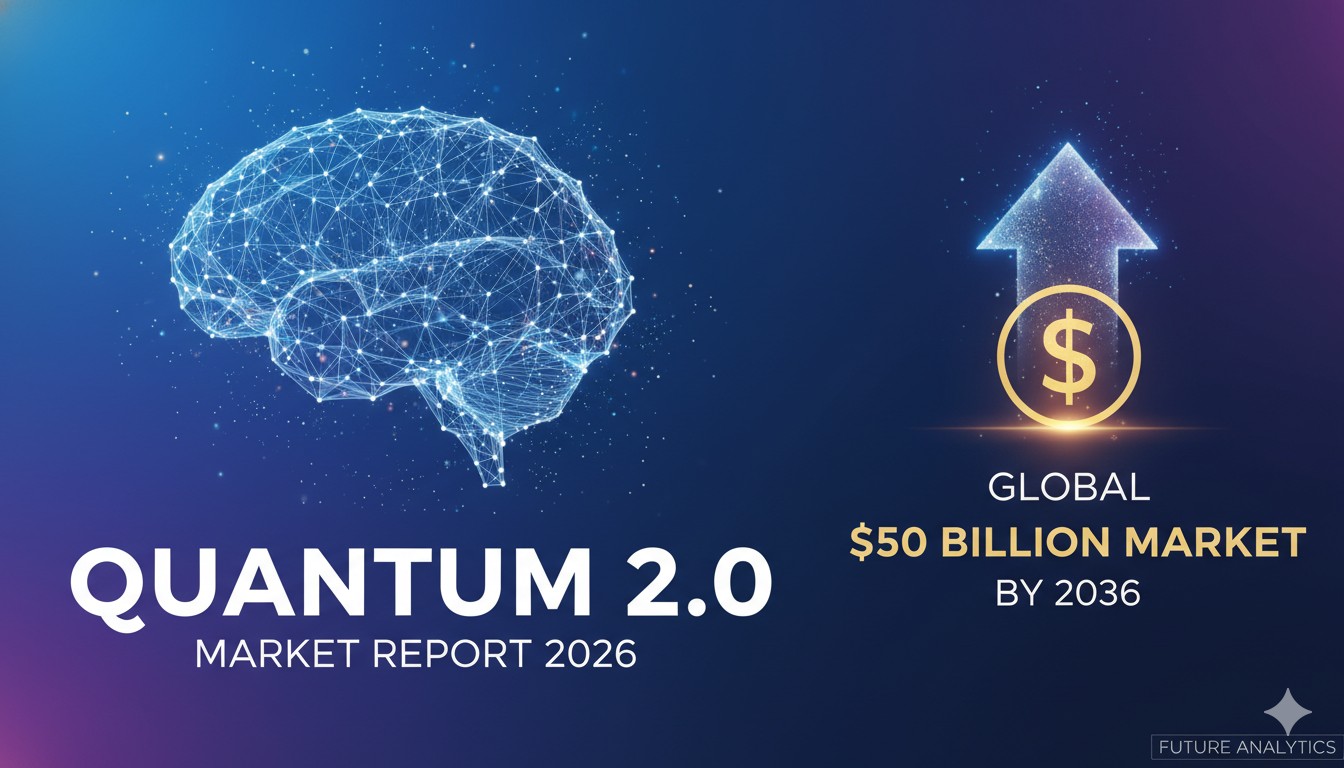
The Quantum 2.0 sector, encompassing advanced quantum computing, sensing, communications, simulation, and related technologies, stands at the threshold of explosive expansion. Starting from approximately $3 billion in 2026, the global market is projected to surpass $50 billion by 2036, fueled by breakthroughs in scalable qubit systems, fault-tolerant architectures, and cross-industry adoption. Key drivers include surging government and private investments exceeding $40 billion cumulatively, rapid hardware scaling toward logical qubits, and transformative applications in finance, pharmaceuticals, materials science, optimization, and secure networks. While challenges like error rates and integration persist, the trajectory points to a seismic shift, unlocking unprecedented computational power and precision that classical systems cannot match.
Quantum 2.0 Market Dynamics in 2026 and Beyond
The Quantum 2.0 era marks the transition from foundational quantum research to engineered, controllable systems at scale. This second quantum revolution builds on principles like superposition and entanglement to deliver practical advantages over classical computing in specific domains.
In 2026, the market hovers around $3 billion, with quantum computing hardware and cloud-accessible platforms leading revenue streams. Neutral-atom and superconducting qubit technologies dominate early deployments, achieving physical qubit counts in the thousands for select systems. Cloud-based services from major players lower barriers, enabling enterprises to experiment without massive upfront infrastructure costs.
Growth accelerates through the decade as fault-tolerant milestones emerge. By the early 2030s, hybrid quantum-classical models tackle real-world problems in optimization and simulation, driving adoption in high-value sectors. Projections indicate the total addressable market across quantum computing, sensing, and communications climbs steadily, reaching over $50 billion by 2036 at a compound annual growth rate exceeding 30%.
Key Market Segments and Projections
Quantum computing forms the largest pillar, with hardware, software, and services contributing the bulk of value. Early focus lies on noisy intermediate-scale quantum (NISQ) devices for near-term advantages in machine learning and material modeling.
Quantum sensing gains traction through ultra-precise measurements in navigation, medical imaging, and geophysical exploration. Miniaturization efforts make these systems more deployable, expanding beyond defense into commercial applications.
Quantum communications, particularly quantum key distribution (QKD), address rising cybersecurity threats. Networks integrating quantum-secure protocols emerge in critical infrastructure, with governments prioritizing post-quantum cryptography transitions.
The following table outlines projected market evolution:
| Year | Estimated Market Size (Global, USD Billion) | Primary Growth Drivers | Dominant Segments |
|---|---|---|---|
| 2026 | ~3 | Cloud access, initial enterprise pilots | Quantum computing hardware/services |
| 2030 | 10-20 | Fault-tolerant prototypes, industry partnerships | Computing + sensing |
| 2035 | 28-72 (computing alone in broader estimates) | Scalable logical qubits, cross-sector adoption | Full Quantum 2.0 stack |
| 2036 | >50 | Mature commercialization, widespread integration | Computing, communications, sensing |
These figures reflect aggregated insights from hardware roadmaps and adoption curves, with quantum computing often comprising the majority share.
Technological Advancements Driving Momentum
Hardware progress remains central. Superconducting circuits, trapped ions, neutral atoms, and photonic approaches each advance toward higher qubit fidelity and coherence times. Neutral-atom platforms show promise for rapid scaling, targeting arrays of tens of thousands by the late 2020s.
Error correction techniques evolve, shifting from physical to logical qubits. Systems demonstrating basic error-corrected operations appear in prototypes, paving the way for reliable computations.
Software ecosystems mature with quantum algorithms optimized for NISQ constraints and hybrid workflows. Tools for quantum machine learning, chemistry simulation, and optimization gain enterprise traction, supported by open-source frameworks and cloud integration.
Industry Applications and Value Creation
Finance leverages quantum for portfolio optimization, risk modeling, and fraud detection, where exponential speedups address complex variables.
In healthcare and pharmaceuticals, molecular simulations accelerate drug discovery, reducing timelines and costs for novel therapies.
Materials science benefits from precise modeling of quantum systems, enabling breakthroughs in batteries, superconductors, and catalysts.
Defense and security sectors prioritize quantum sensing for enhanced detection and quantum communications for unbreakable encryption.
Mobility and logistics gain from advanced optimization algorithms solving routing and supply chain challenges more efficiently.
Economic value at stake across these areas could reach trillions by the mid-2030s through efficiency gains and new capabilities.
Investment Landscape and Ecosystem
Private investments surpass $5 billion cumulatively, with venture funding targeting startups in hardware, software, and applications. Established tech giants expand quantum divisions, offering cloud platforms and R&D collaborations.
Governments commit over $40 billion globally through national initiatives, funding research centers, talent development, and infrastructure. International partnerships foster standards and shared resources.
Challenges on the Horizon
Scalability hurdles include maintaining qubit coherence at larger scales and managing error rates. Supply chain dependencies on specialized materials pose risks.
Integration with classical systems requires new architectures, while talent shortages demand expanded education programs.
Regulatory frameworks for quantum-safe cryptography and export controls evolve to balance innovation and security.
Despite these, momentum builds as demonstrations of quantum advantage in practical scenarios validate the technology’s potential.