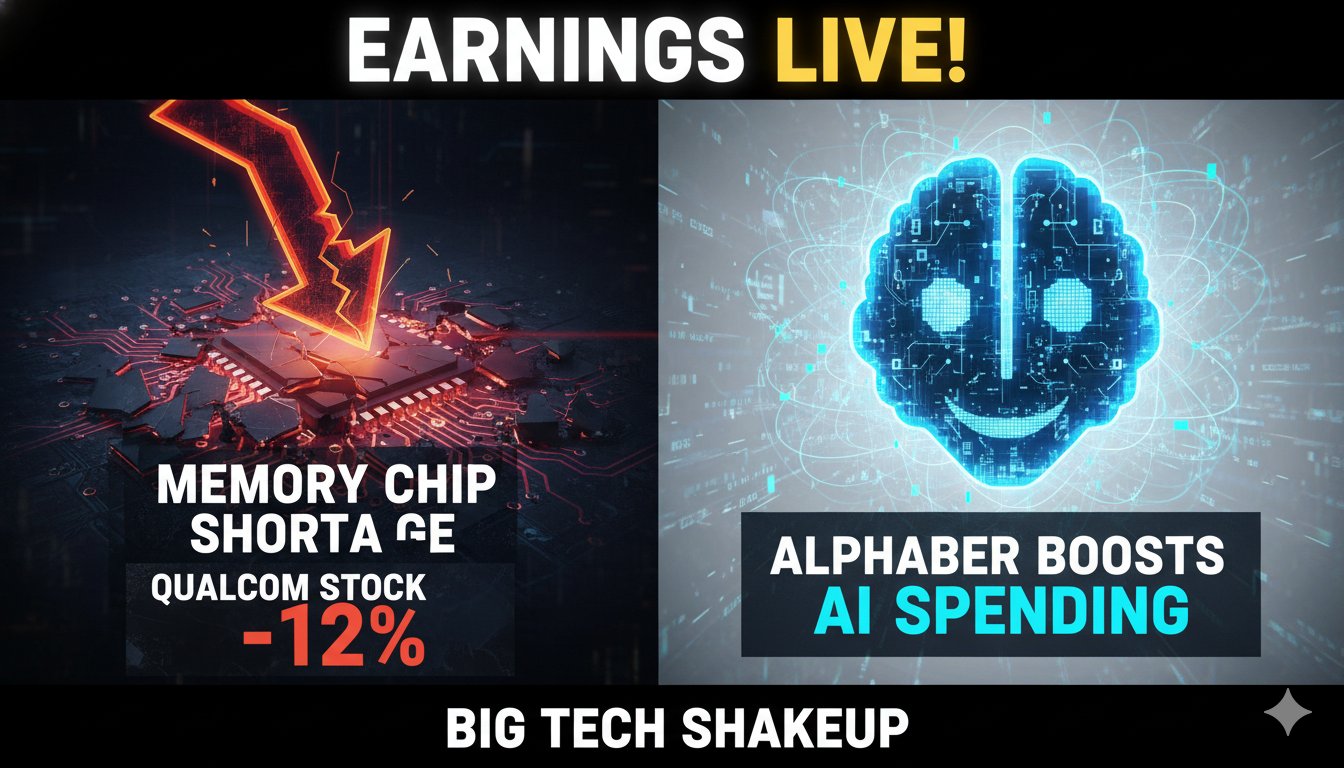
“Qualcomm’s first-quarter fiscal 2026 earnings showcased record revenues of $12.25 billion and non-GAAP EPS of $3.50, but shares plummeted due to a subdued second-quarter outlook impacted by global memory chip shortages affecting handset demand. Meanwhile, Alphabet reported robust fourth-quarter 2025 results with revenues hitting $113.8 billion and EPS of $2.82, driven by surging Google Cloud growth, while announcing a massive $175 billion to $185 billion capital expenditure plan for 2026 to fuel AI expansion.”
Earnings Breakdown: Qualcomm’s Performance and Challenges
Qualcomm delivered a mixed bag in its first-quarter fiscal 2026 results, achieving record-breaking revenues but facing headwinds from persistent supply chain disruptions in the semiconductor industry. Total revenues climbed to $12.25 billion, marking a 5% increase from the previous year, fueled primarily by strength in its core chipmaking division and licensing operations. The Qualcomm CDMA Technologies segment, which encompasses handset, automotive, and IoT chips, generated $10.61 billion, up 5% year-over-year, while the Qualcomm Technology Licensing segment brought in $1.59 billion, a 4% rise.
Breaking down the numbers further, handset revenues within the CDMA Technologies unit reached $7.2 billion, reflecting robust demand for premium Snapdragon processors integrated into flagship smartphones. However, the standout performer was the automotive sector, where revenues exceeded $1 billion for the second consecutive quarter, driven by expanding adoption of Qualcomm’s connected vehicle platforms in electric and autonomous cars. This growth underscores the company’s diversification efforts beyond traditional mobile chips, with automotive now representing a key pillar for future expansion.
On the profitability front, GAAP net income stood at $3 billion, or $2.78 per share, a slight dip of 6% from the prior year, attributed to higher operational costs amid inflationary pressures. Non-GAAP earnings per share, which exclude certain one-time items like acquisition-related expenses, came in stronger at $3.50, surpassing analyst expectations and highlighting operational efficiency. Earnings before taxes totaled $3.55 billion on a GAAP basis, with operating income at $3.37 billion.
Despite these achievements, investor sentiment soured on the company’s forward guidance, which pointed to ongoing challenges from a global memory chip shortage. This supply crunch, stemming from production constraints at major memory manufacturers, has led to elevated pricing and reduced availability, dampening demand from key handset customers. For the second quarter, Qualcomm anticipates revenues between $10.2 billion and $11 billion, with non-GAAP EPS ranging from $2.45 to $2.65. This outlook falls short of market consensus, prompting concerns about near-term growth in the smartphone market.
To illustrate the segment-wise performance and year-over-year changes:
| Segment | Q1 FY2026 Revenues ($B) | Q1 FY2025 Revenues ($B) | % Change | EBT ($B) | EBT Margin |
|---|---|---|---|---|---|
| Qualcomm CDMA Technologies (QCT) | 10.61 | 10.08 | +5% | 3.30 | 31% |
| Qualcomm Technology Licensing (QTL) | 1.59 | 1.54 | +4% | 1.23 | 77% |
| Total | 12.25 | 11.67 | +5% | 4.37 (Non-GAAP) | 36% |
The table highlights the resilience in licensing margins, which benefited from stable patent agreements with major device makers. Equipment and services revenues totaled $10.47 billion, while licensing added $1.79 billion, reflecting Qualcomm’s dual revenue model.
Looking deeper into operational dynamics, research and development expenses rose to $2.45 billion, a 10% increase, as the company invests heavily in next-generation AI-enabled chips and 6G wireless technologies. Selling, general, and administrative costs climbed to $865 million, partly due to the recent acquisition of Alphawave Semi, a move aimed at bolstering Qualcomm’s presence in data center infrastructure. This strategic buyout, completed in the quarter, positions Qualcomm to capitalize on the booming demand for high-speed connectivity in AI-driven computing environments.
The memory shortage’s ripple effects are particularly acute in the handset division, where several major customers have scaled back orders due to component constraints. Industry-wide, this issue has disrupted production timelines for premium and high-tier smartphones, even as end-consumer demand remains healthy. Qualcomm’s leadership emphasized that while the shortage is a temporary hurdle, the company’s long-term trajectory remains intact, with fiscal 2029 revenue targets still on track, projecting significant growth in automotive, industrial AI, and edge computing.
Alphabet’s Surge: AI-Driven Growth and Spending Spree
Shifting focus to Alphabet, the Google parent company capped off 2025 with a stellar fourth-quarter performance, underscoring its dominance in digital advertising, cloud computing, and emerging AI technologies. Revenues soared 18% to $113.8 billion, pushing annual totals past $400 billion for the first time at $402.8 billion. This acceleration was propelled by a 17% constant currency growth rate, demonstrating resilience against currency fluctuations.
The Google Services segment, which includes Search, YouTube, and consumer subscriptions, generated $95.9 billion, up 14% year-over-year. Within this, Google Search and other revenues hit $63.1 billion, a 17% jump, as AI enhancements like Gemini-powered overviews boosted user engagement and ad monetization. YouTube ads contributed $11.4 billion, growing 9%, while subscriptions, platforms, and devices added $13.6 billion, up 17%, driven by surging adoption of YouTube Premium, Google One storage, and Pixel hardware.
Google Cloud emerged as the star performer, with revenues skyrocketing 48% to $17.7 billion, fueled by enterprise demand for AI infrastructure and solutions. This segment’s annual run rate exceeded $70 billion, reflecting Alphabet’s successful pivot toward cloud-based AI tools, including Gemini models processing over 10 billion tokens per minute. Operating income for the quarter reached $35.9 billion, yielding a 32% margin, while net income climbed 30% to $34.5 billion, or $2.82 per share.
A key highlight was Alphabet’s aggressive investment strategy in AI, with capital expenditures projected to balloon to $175 billion to $185 billion in 2026—nearly double the $91.4 billion spent in 2025. This ramp-up targets data center expansions, custom AI chip development like Tensor Processing Units, and infrastructure to support generative AI applications across Search, Cloud, and consumer products. The move signals Alphabet’s commitment to maintaining a competitive edge against rivals in the AI arms race, where infrastructure scale is critical for training large language models.
For a clearer view of revenue streams:
| Revenue Category | Q4 2025 ($B) | Q4 2024 ($B) | % Change | Full Year 2025 ($B) |
|---|---|---|---|---|
| Google Search & Other | 63.1 | 54.0 | +17% | 240.5 |
| YouTube Ads | 11.4 | 10.5 | +9% | 45.2 |
| Google Network | 7.8 | 8.0 | -2% | 31.0 |
| Google Subscriptions, Platforms, Devices | 13.6 | 11.6 | +17% | 50.1 |
| Google Cloud | 17.7 | 12.0 | +48% | 70.0+ (Run Rate) |
| Other Bets | 0.4 | 0.4 | 0% | 1.5 |
| Total | 113.8 | 96.5 | +18% | 402.8 |
The table reveals the diversification beyond advertising, with Cloud now contributing significantly to the bottom line. Operating income from Google Services totaled $40.1 billion, while Cloud swung to $5.3 billion in profitability, a marked improvement from prior periods.
In terms of user metrics, YouTube’s combined ads and subscriptions surpassed $60 billion annually, with over 325 million paid subscriptions across Alphabet’s consumer ecosystem. The Gemini app has amassed 750 million monthly active users, illustrating rapid AI adoption. However, challenges persist in Other Bets, including Waymo’s autonomous driving unit, which incurred a $2.1 billion compensation charge, contributing to a $3.6 billion operating loss in the segment.
Alphabet’s board also declared a quarterly cash dividend of $0.21 per share, payable in March 2026, reaffirming its shareholder-friendly stance. With AI continuing to drive search usage to record levels, the company is poised for sustained growth, though the hefty capex outlay raises questions about near-term free cash flow impacts.
Market Reactions and Broader Implications
In after-hours trading, Qualcomm’s shares tumbled approximately 9%, erasing gains from the earnings beat and reflecting investor unease over the memory bottleneck’s duration. This decline could pressure the broader semiconductor index, as supply chain vulnerabilities highlight risks in the global chip ecosystem.
Conversely, Alphabet’s results buoyed optimism in the tech sector, with its stock poised for gains amid the AI spending narrative. The capex forecast, while ambitious, aligns with industry trends where hyperscalers are pouring billions into AI infrastructure to meet exploding demand from enterprises and developers.
These earnings underscore divergent paths in the tech landscape: Qualcomm grappling with cyclical supply issues in mobile, while Alphabet leverages AI tailwinds for exponential cloud expansion. Investors will monitor how memory constraints resolve and whether Alphabet’s investments translate into market share gains against competitors.
Disclaimer: This news report is for informational purposes only and does not constitute financial advice, investment recommendations, or endorsements. It is based on publicly available data and should not be relied upon for making financial decisions.