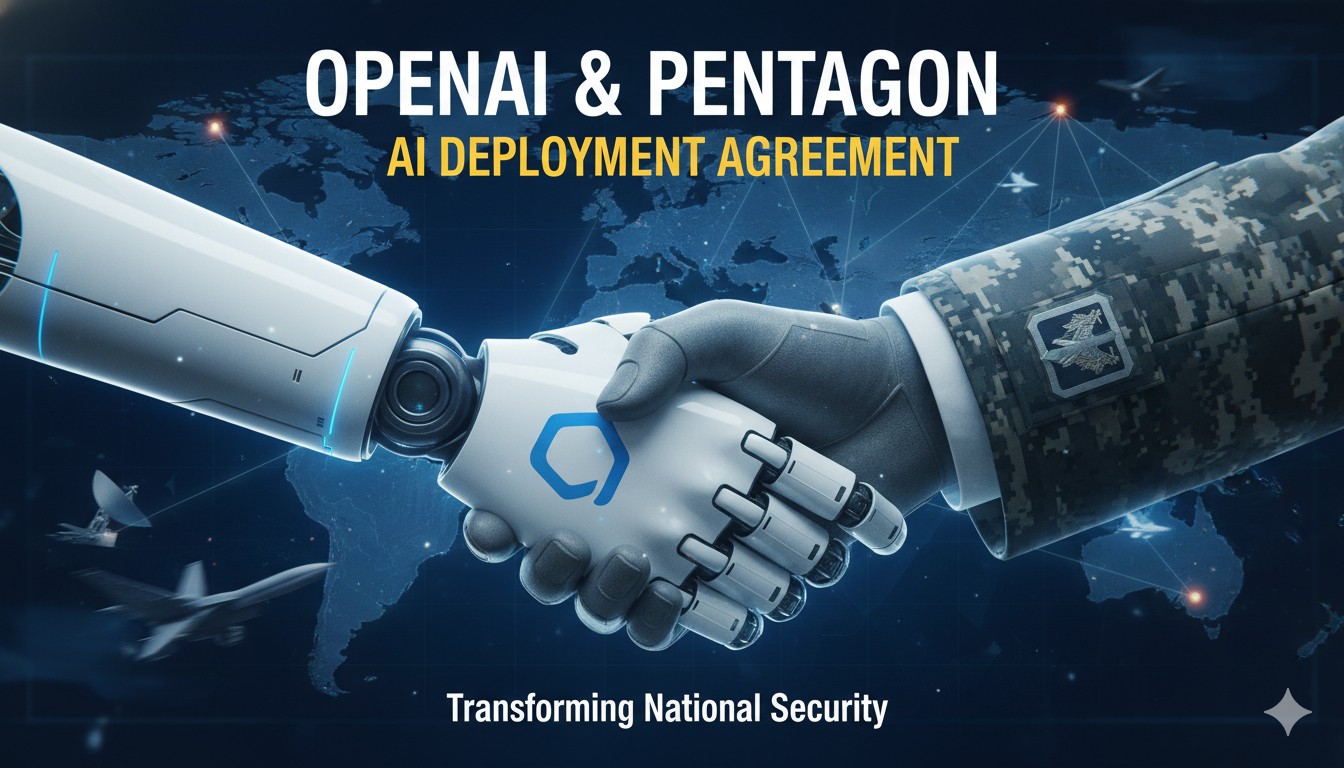
OpenAI has reached an agreement with the U.S. Department of Defense to deploy its advanced AI models within the Pentagon’s classified networks. Announced late Friday by CEO Sam Altman, the deal incorporates key safety principles prohibiting domestic mass surveillance and ensuring human responsibility for any use of force, including in autonomous weapon systems. This development follows the abrupt severance of ties with rival Anthropic, which refused similar concessions, leading to a government directive halting its use across federal agencies. The agreement allows lawful applications of OpenAI’s technology while implementing technical guardrails, marking a significant step in integrating frontier AI into national security operations amid heightened geopolitical tensions.
OpenAI Secures Pentagon Partnership for Classified AI Deployment
In a swift turn of events reshaping the landscape of AI and national defense, OpenAI has finalized an agreement with the U.S. Department of Defense (DoD) to integrate its powerful AI models into classified military networks. The announcement, delivered personally by CEO Sam Altman via a detailed post on X late Friday evening, highlights a collaborative approach that balances technological advancement with ethical constraints.
The core of the deal centers on deploying OpenAI’s latest large language models and related AI systems within secure, classified environments managed by the DoD. This move enables military personnel to leverage AI for intelligence analysis, strategic planning, logistics optimization, and other mission-critical functions where rapid data processing and pattern recognition provide decisive advantages. Unlike broader commercial deployments, this integration occurs in highly restricted cloud-based classified networks, ensuring compliance with stringent security protocols.
A pivotal aspect of the agreement is OpenAI’s insistence on maintaining its foundational safety red lines. Altman emphasized two primary principles: a strict prohibition on using the technology for domestic mass surveillance within the United States, and the requirement that humans retain ultimate responsibility for any application of force, explicitly including scenarios involving autonomous weapon systems. These safeguards have been embedded directly into the contract terms, with OpenAI implementing technical guardrails—such as model-level refusals, layered safety stacks, and deployment controls—to enforce them. The DoD, in turn, has reportedly demonstrated respect for these boundaries, agreeing to reflect them in policy and practice.
This partnership emerges against the backdrop of a high-profile fallout with competitor Anthropic. Earlier on the same day, President Donald Trump directed all federal agencies to cease using Anthropic’s AI tools, including its Claude models, following a breakdown in negotiations over a substantial defense contract. Anthropic had pushed for similar restrictions on military applications, particularly barring use in fully autonomous lethal systems or widespread domestic monitoring of U.S. citizens. When talks collapsed, Defense Secretary Pete Hegseth labeled Anthropic a supply chain risk to national security, effectively blacklisting the company from Pentagon business and triggering a phase-out period for existing engagements.
OpenAI’s ability to reach terms where Anthropic could not underscores differences in negotiation strategies and technical approaches. While Anthropic reportedly sought hard contractual vetoes over certain uses, OpenAI opted for a combination of enforceable principles, custom-built safeguards, and assurances that models would not be compelled to violate their core alignments. This has allowed deployment to proceed without compromising OpenAI’s public commitments to responsible AI development.
The timing carries broader implications for the AI industry and U.S. defense posture. With geopolitical rivalries intensifying—particularly in areas like cyber operations, intelligence gathering, and autonomous systems—the Pentagon has prioritized accelerating AI adoption to maintain strategic edges. OpenAI’s models, renowned for their reasoning capabilities, multimodal processing, and adaptability, are seen as valuable assets in analyzing vast datasets from satellites, signals intelligence, and battlefield sensors.
Industry observers note that this agreement positions OpenAI favorably amid competition from other players already engaged with the DoD, including Google and xAI. It also highlights evolving government attitudes toward AI safety: rather than outright rejection of restrictions, the DoD appears willing to accommodate them when framed as mutual commitments to lawful and ethical use.
From a business perspective, the deal opens new revenue streams for OpenAI through government contracts, potentially involving customized fine-tuning, dedicated inference capacity, or ongoing support for classified deployments. While financial details remain undisclosed, such partnerships often carry multi-year commitments and significant scaling requirements.
Critics may question whether technical guardrails can fully prevent misuse in high-stakes military contexts, where operational pressures could test boundaries. Proponents argue that formalizing these principles in agreements with the world’s most powerful military represents progress in aligning frontier technology with democratic values.
As AI continues to permeate national security, this OpenAI-DoD pact sets a precedent for how private-sector innovators and government entities can collaborate on powerful tools while navigating ethical minefields. The agreement reflects a pragmatic path forward, prioritizing both innovation and accountability in an era where AI shapes strategic outcomes.
Disclaimer: This is a news report based on publicly available information and statements from involved parties. It does not constitute financial, investment, or policy advice.