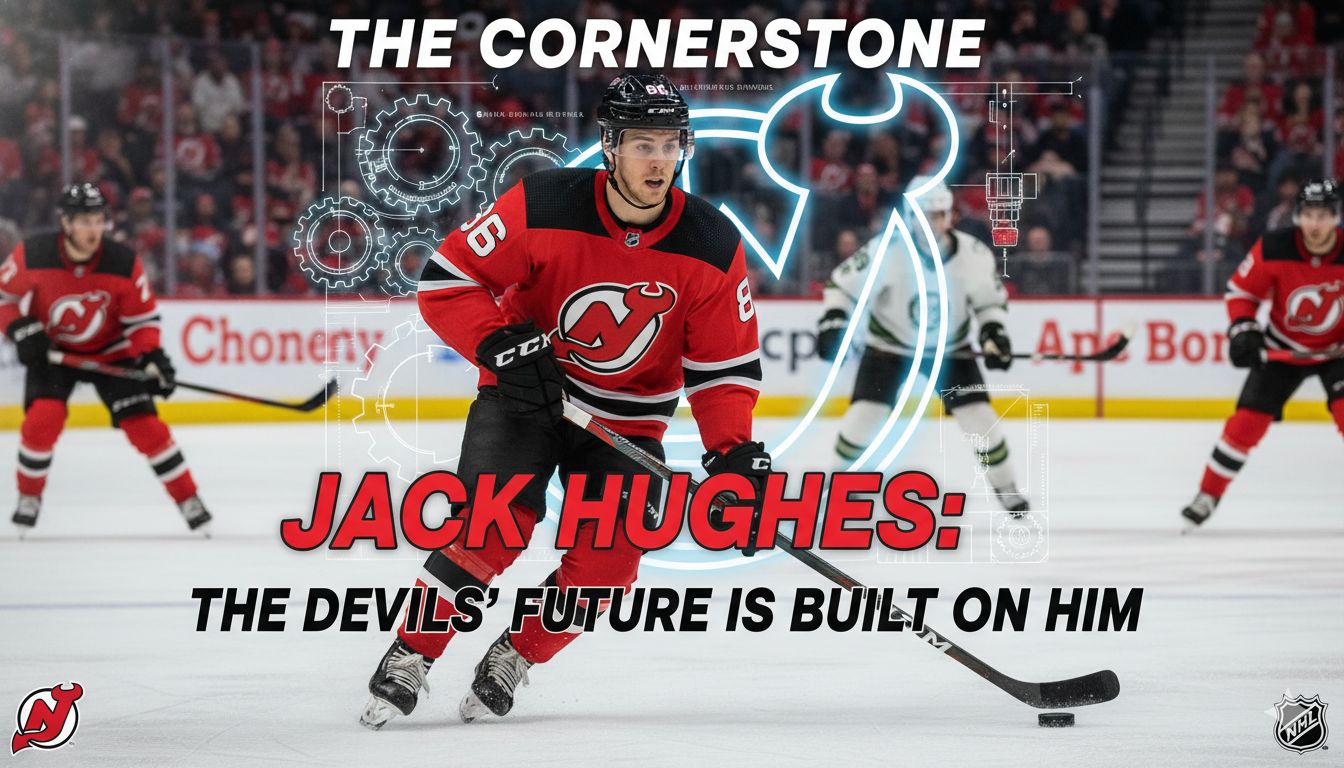
Jack Hughes delivered a historic performance at the 2026 Winter Olympics, capping it with the overtime “golden goal” that secured Team USA’s first men’s hockey gold medal since 1980 against Canada. Despite a season hampered by injuries and limited to 36 games with the New Jersey Devils, where he has posted 12 goals and 24 assists for 36 points, his elite playmaking, midrange scoring prowess, and ability to elevate in high-stakes moments reaffirm why he remains the cornerstone for the franchise’s future success. As the Devils sit at 28-27-2 and hover around the playoff bubble, Hughes’ Olympic heroics provide a blueprint for leadership and offensive dominance that the team must fully embrace.
Jack Hughes’ Olympic Triumph Reinforces His Status as the Devils’ Franchise Pillar
Jack Hughes has once again proven why he deserves to be the foundational piece of the New Jersey Devils’ rebuild and ongoing push toward contention. His standout showing at the Milano Cortina 2026 Winter Olympics, particularly the dramatic overtime winner in the gold medal game against Canada, highlighted the exact qualities that make him an elite NHL talent: speed, vision, resilience under pressure, and an uncanny ability to deliver when the lights are brightest.
The 24-year-old center, selected first overall by the Devils in 2019, entered the Olympic tournament after a challenging start to the 2025-26 NHL season. Limited to just 36 games due to recurring injuries—including a lower-body issue that sidelined him for the Devils’ final three contests before the break—Hughes had accumulated 12 goals and 24 assists for 36 points, with a minus-6 rating. His point-per-game pace of 1.00 remained solid, especially considering his heavy usage at even strength and on the power play, where he notched 2 goals and 11 assists. He averaged 20:57 of ice time per game, firing 127 shots at a 9.4% shooting percentage.
Yet the Olympics showcased Hughes at his absolute best. Representing Team USA, he tallied four goals and three assists for seven points across six games, placing him among the tournament’s top scorers. His performance built steadily: strong primary assists in the opener against Latvia, consistent contributions on a line with Tage Thompson and Dylan Larkin, and a multi-goal outburst in the semifinal against Slovakia. The pinnacle came in the gold medal final, where Hughes scored the game-winner 1:41 into overtime on a wrist shot off a cross-ice feed from Zach Werenski, propelling the U.S. to a 2-1 victory over Canada. This marked the Americans’ first Olympic men’s hockey gold since the Miracle on Ice in 1980 and etched Hughes into national lore, complete with an iconic post-game image of him draped in the flag, sporting a bloodied, toothless grin after taking a high stick earlier in the tournament.
What stood out was Hughes’ ability to thrive despite not being handed prime minutes on a star-studded roster. He earned increased responsibility as the games progressed—time on the second power-play unit and even shifts in 3-on-3 overtime against the likes of Connor McDavid, Nathan MacKinnon, and Cale Makar. Advanced metrics from his NHL play translated seamlessly to the international stage, particularly his effectiveness from midrange areas, where he excels at creating and finishing chances. Since the 2021-22 season, Hughes ranks among the league’s top forwards in points per game, underscoring his high offensive ceiling as he enters his prime years.
For the Devils, this Olympic run serves as a powerful reminder amid a middling campaign. The team currently holds a 28-27-2 record for 58 points through 57 games, placing them ninth in the Metropolitan Division and on the fringes of the Eastern Conference playoff picture. Goal differential sits at -29, with 146 goals scored and 175 allowed. Hughes’ absence earlier in the season coincided with struggles, but his presence drives the offense: his 36 points lead or tie for the team lead in key categories despite playing fewer games than others like Nico Hischier (42 points in more contests).
Key Performance Metrics Comparison (2025-26 Season)
Games Played : 36 (Hughes) vs. higher for most teammates
Points : 36 (1.00 PPG)
Goals : 12
Assists : 24 (strong playmaking focus)
Power Play Points : 13 (2G, 11A)
Shots : 127 (9.4% shooting)
Ice Time : 20:57 average
Plus/Minus : -6 (reflective of team defensive issues)
Hughes’ underlying impact goes beyond raw numbers. His skating allows him to evade pressure, generate zone entries, and create for linemates like Jesper Bratt or Timo Meier. When healthy, he transforms the power play into a dangerous unit, drawing defenders and opening lanes. The injuries have been frustrating—a pattern over recent seasons—but when available, he consistently performs at an elite level.
The timing of his Olympic success couldn’t be more opportune. With the Devils resuming play post-break, including a high-profile matchup against the Sabres, Hughes returns as a gold medalist carrying momentum. His leadership, now validated on the world stage, positions him perfectly to guide younger talents like brother Luke Hughes and others. The franchise has invested heavily in building around him since the draft, and moments like the golden goal demonstrate why that bet remains sound.
His performance also quiets any lingering doubts about commitment or durability optics. Hughes proved he can handle the physicality and scrutiny of the biggest stage, emerging not just as a participant but as the decisive factor. For a Devils squad needing a spark to climb back into playoff contention, embracing Hughes as the undisputed leader—both on and off the ice—offers the clearest path forward.
Disclaimer: This is an opinion-based analysis reflecting current events and statistics in professional hockey. It is for informational and entertainment purposes only and does not constitute betting advice or investment recommendations.