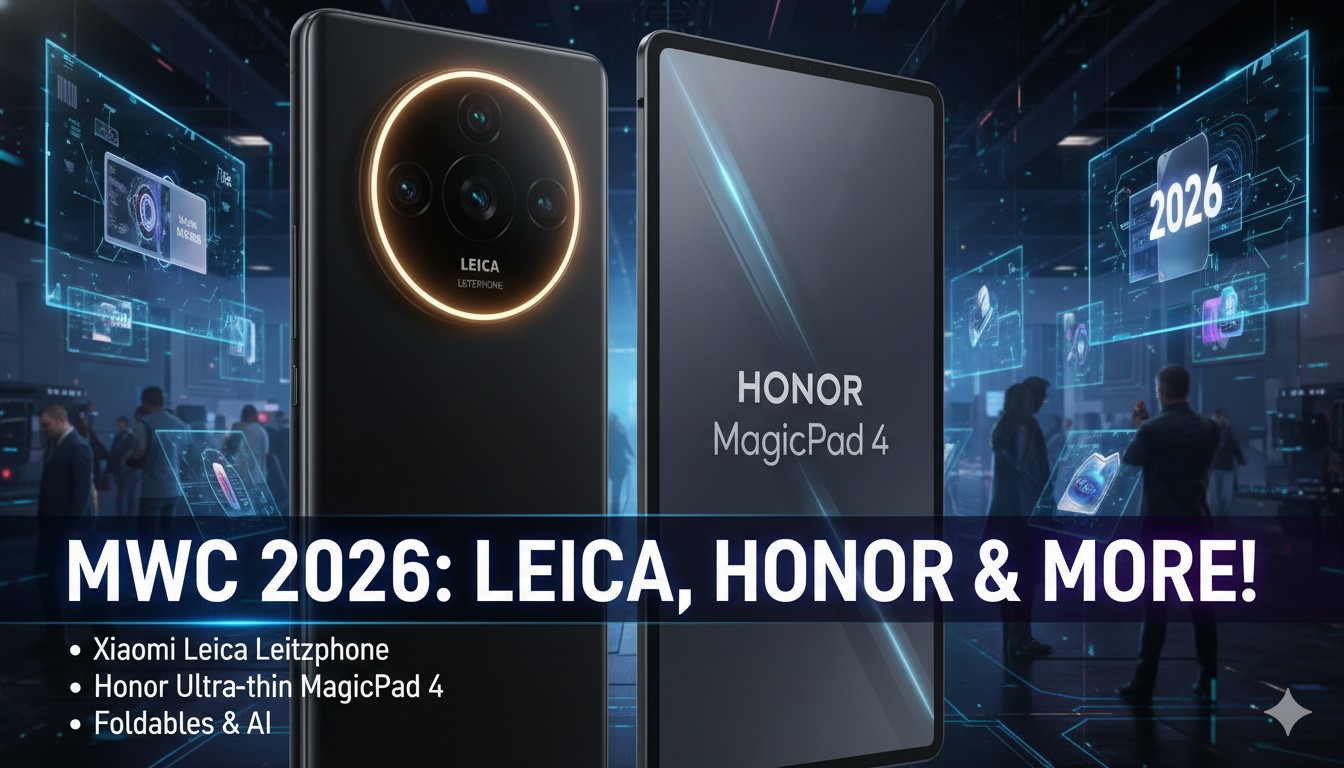
“Mobile World Congress 2026 showcased a surge in premium camera-focused smartphones, ultra-thin tablets, and AI-driven ecosystems, headlined by Xiaomi’s Leica Leitzphone collaboration and Honor’s world-thinnest MagicPad 4, amid broader themes of intelligent connectivity and emerging 6G technologies.”
Everything Announced at MWC 2026: Leica Leitzphone, Honor MagicPad 4, and Key Highlights
The annual Mobile World Congress in Barcelona once again served as the global stage for mobile innovation, running from March 2 to 5, 2026, at Fira Gran Via. This year’s event emphasized the convergence of connectivity and intelligence in what organizers termed the “IQ Era,” with heavy focus on AI-native experiences, advanced imaging, and slimmer form factors. While many announcements targeted global markets outside the US, they set important benchmarks for flagship performance, design innovation, and future connectivity.
Xiaomi kicked off the proceedings with a high-profile event, renewing and expanding its long-standing collaboration with Leica. The standout was the Leica Leitzphone powered by Xiaomi, a premium device marking Leica’s push into international smartphone markets beyond previous Japan-exclusive models. This handset builds on Xiaomi’s flagship imaging prowess, featuring a massive 1-inch main camera sensor for exceptional low-light performance and detail capture. It includes a physical Leica Camera Ring—a knurled mechanical dial around the camera module—for intuitive zoom and settings adjustments, evoking traditional camera handling.
The Leitzphone offers a clean, minimalist Leica-designed interface that prioritizes essentials during shooting, with options to hide modes and labels for a focused experience. Users can toggle between a dedicated monochrome mode for classic black-and-white photography and signature Leica filters for vibrant, contrast-rich results. It supports high-resolution 200MP captures and advanced optical capabilities, including a versatile zoom range equivalent to 75-100mm with stabilization and autofocus. Available in a refined black and silver finish, the device comes configured with 16GB RAM and 1TB storage, positioning it as a top-tier option for photography enthusiasts. Priced at around €1,999 in select markets, it appeals to those seeking Leica’s heritage in a modern mobile form.
Closely related, Xiaomi also rolled out the global version of its 17 Ultra, which shares much of the imaging hardware with the Leitzphone, including the 1-inch sensor and multi-lens setup. The 17 Ultra emphasizes flagship-level performance with a sleek, durable build and strong processing for on-device AI enhancements. Both devices highlight Xiaomi’s strategy to blend cutting-edge mobile tech with premium brand collaborations, delivering tools that rival dedicated cameras in certain scenarios.
Honor made waves with the MagicPad 4, claiming the title of the world’s thinnest Android tablet at just 4.8mm (excluding the camera bump). This ultra-slim profile—thinner than leading competitors like recent iPad models—pairs with a lightweight 450g chassis, making it exceptionally portable. The tablet sports a large 12.3-inch OLED display with 3000 x 1920 resolution, 165Hz adaptive refresh rate, and peak HDR brightness up to 2400 nits for vivid visuals in gaming, media, and productivity.
Power comes from Qualcomm’s Snapdragon 8 Gen 5 chipset, supported by up to 16GB RAM and 512GB storage. Camera setup includes a 13MP rear and 9MP front shooter, while audio features eight speakers for spatial sound. It supports 66W fast charging and runs on Honor’s MagicOS 10, promising smooth multitasking and AI integrations. The MagicPad 4 targets users seeking premium tablet experiences in the slimmest possible package, potentially influencing future designs across the industry.
Beyond these headliners, MWC 2026 featured broader ecosystem and tech demonstrations. Samsung highlighted advancements in its Galaxy AI, showcasing the S26 series as an “agentic” companion with deeper personalization across phones, wearables like the Galaxy Buds4, and connected devices. The focus was on intuitive AI that anticipates user needs and seamless integration.
Qualcomm and partners demonstrated early 6G prototypes, including AI-native services, sensing-enabled digital twins, and spectrum sharing with 5G. Ericsson collaborated on 6G cm-wave data calls and multi-RAT sharing, pointing to future demands for ultra-high-speed, low-latency applications.
Other notable mentions included Honor’s teased humanoid robotics pivot and experimental concepts like robot-integrated phones, alongside DOOGEE’s AI-focused rugged ecosystem and industry discussions on AI-RAN, satellite connectivity, and memory challenges impacting upgrades.
These announcements underscore a mobile landscape shifting toward AI-embedded hardware, premium collaborations, and boundary-pushing designs, even as many devices remain regionally focused.
Disclaimer: This is a news report summarizing key announcements from the event. Information is based on public disclosures and may evolve with further details.