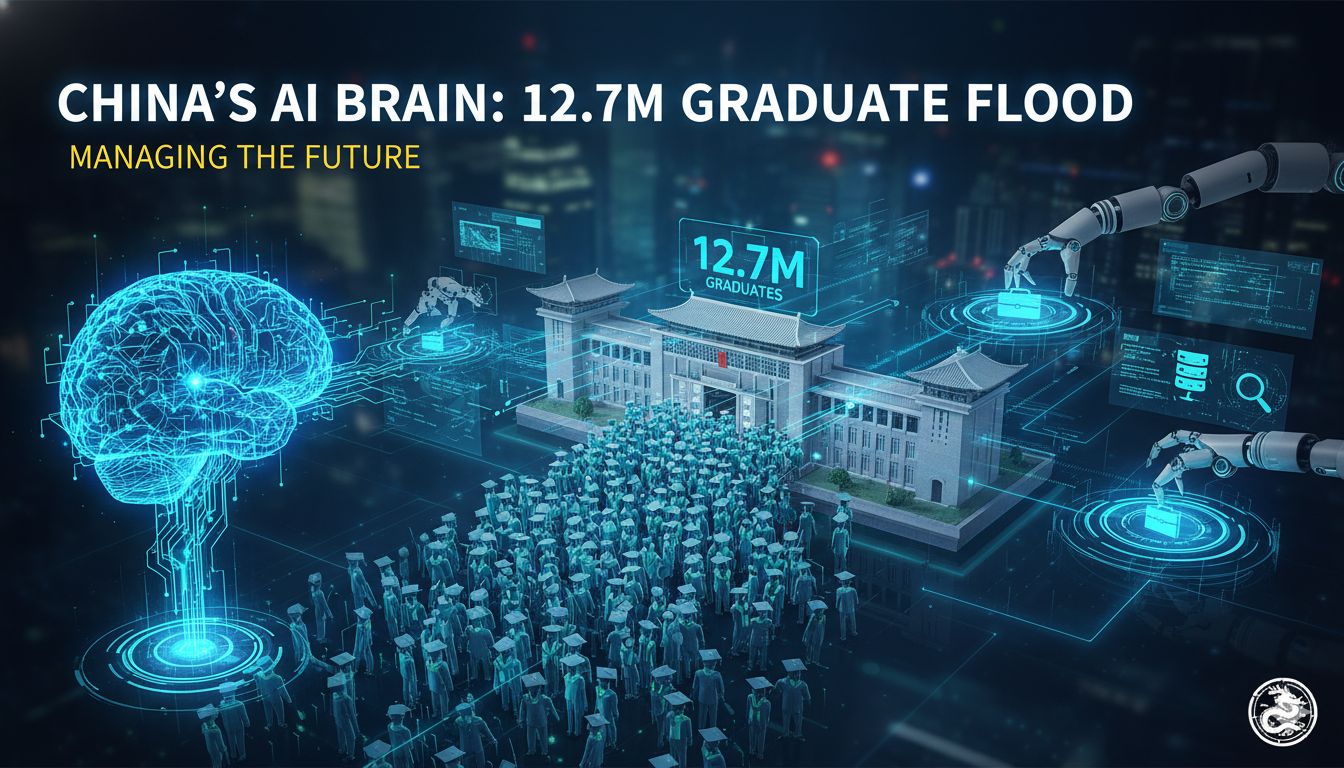
**” In a bold strategic shift, Beijing is leveraging AI not just as an economic growth engine but as a critical tool to create jobs, upskill millions of young professionals, and mitigate the risks of widespread underemployment among the largest graduating class in Chinese history. With the nation’s AI industry already surpassing 1.2 trillion yuan in value and expanding rapidly, this pivot aims to transform potential labor market strain into a catalyst for technological self-reliance and high-quality employment. “**
China’s AI-Driven Response to Historic Graduate Surge
The sheer scale of the 2026 graduating class—equivalent to more than the entire population of many mid-sized nations—has intensified long-standing concerns about job creation in China’s evolving economy. Officials have outlined plans to generate over 12 million urban jobs this year while emphasizing AI’s role in upgrading traditional industries and spawning new opportunities.
At the core of this strategy is the “AI+” initiative, which integrates artificial intelligence across sectors to boost productivity and demand for skilled labor. The Ministry of Human Resources and Social Security has highlighted using AI to enhance job matching, upgrade roles in manufacturing and services, and open channels for graduates to demonstrate capabilities in emerging fields. Large-scale internship programs and targeted training are being rolled out, focusing on high-tech areas where talent shortages persist.
China’s core AI sector reached an output value exceeding 1.2 trillion yuan (approximately $165-174 billion) in 2025, with over 6,200 companies active in the space. More than 30% of large manufacturing firms have adopted AI applications, particularly in high-tech and equipment manufacturing segments that contribute significantly to value-added output. This rapid integration creates demand for roles in areas like large language models, computer vision, generative AI, robotics, and AI governance.
Key Employment Challenges and AI’s Mitigating Role
The graduate wave compounds existing pressures. Youth unemployment has hovered at elevated levels, with surveys showing widespread anxiety over AI-driven job displacement—particularly in entry-level administrative and routine positions. Over half of professionals believe low-skilled roles could be automated within years, while Generation Z workers rank AI replacement as a top career risk.
Yet Beijing views AI as a net positive force. Rather than purely displacing jobs, the technology is positioned to augment human capabilities and generate demand for new skill sets. The government promotes reskilling in AI literacy, with universities establishing dedicated programs and micro-majors in artificial intelligence, data science, intelligent manufacturing, and related fields. Many institutions now require AI-related coursework for all students to build broad competencies.
Returnees from overseas education are flocking back, drawn by opportunities in AI, advanced manufacturing, aerospace, and smart hardware. Applications in these sectors have surged, with salaries for specialized roles—especially at the doctoral level—reaching premium levels. This brain gain further fuels innovation in high-barrier industries.
Sector-Specific Opportunities and Projections
AI-related employment has shown resilience and growth despite broader market tightness. Job postings in AI fields have increased, with applicant interest rising sharply as graduates seek competitive edges through tools like resume optimizers and interview simulators powered by AI itself.
Projected AI Talent Demand in China
By 2030: Up to 6 million AI professionals needed
Current shortfall estimate: Around 4 million workers
Annual growth in technical AI roles: 26% through 2033
Key high-demand areas: Multimodal AI, AI ethics, prompt engineering, generative AI systems
Graduates with STEM backgrounds, particularly in engineering and computer science, are best positioned, though cross-disciplinary skills combining AI with domain expertise (e.g., healthcare AI or industrial applications) command premiums.
The government has expanded digital employment platforms using AI and big data for matching, hosting millions of openings and virtual fairs. Regional efforts coordinate with universities to prioritize quality placements over quantity.
Broader Economic Context
This pivot aligns with national goals of technological self-reliance amid external pressures. AI is seen as central to “new productive forces,” driving efficiency in legacy sectors while birthing industries like humanoid robotics (with hundreds of models emerging) and intelligent hardware.
While challenges remain—skills mismatches, potential short-term displacement, and competition for top roles—the strategy bets that accelerating AI adoption will absorb much of the graduate surplus into productive, future-oriented work. Success hinges on sustained investment in education reform, industry collaboration, and adaptive policies that turn demographic pressure into a competitive advantage in the global AI race.
Disclaimer: This is a news analysis based on current economic and labor market developments.