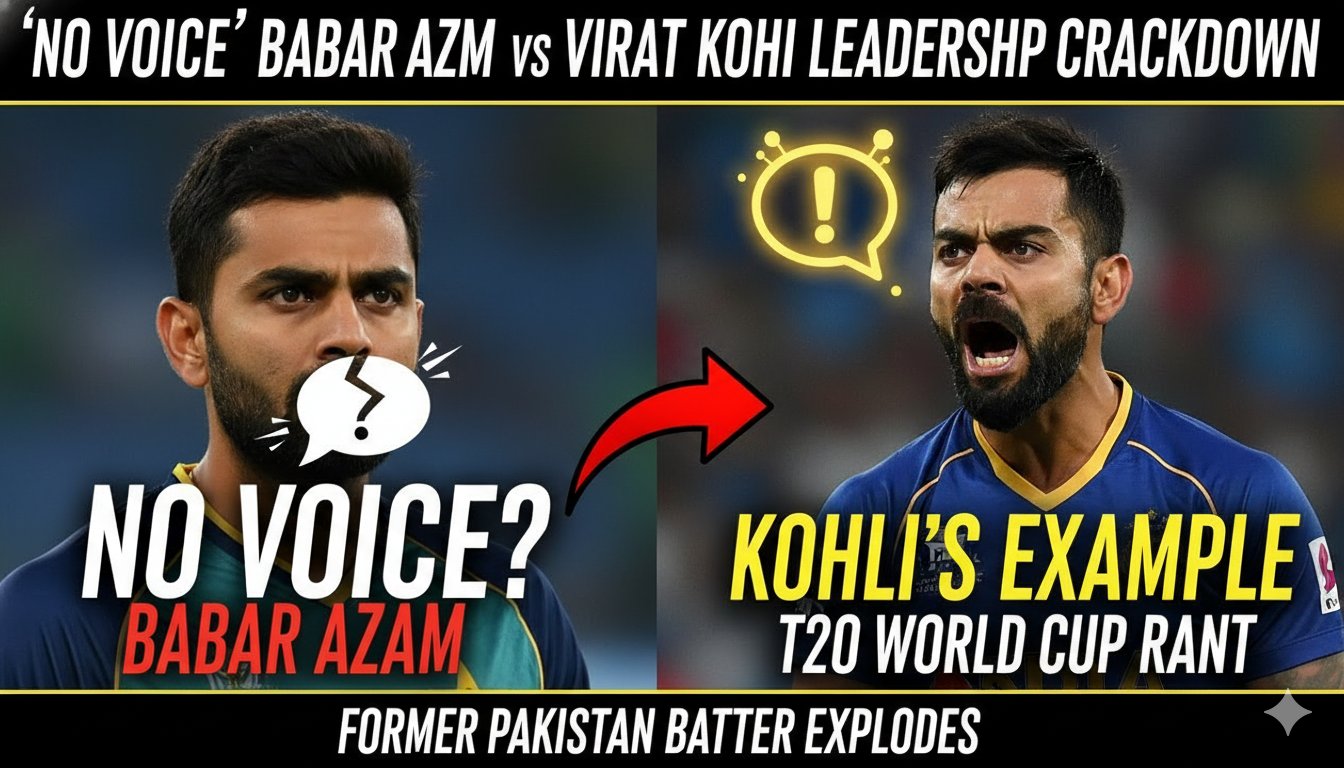
“Babar Azam and Fakhar Zaman don’t have a voice. How come they agreed to bat in the middle order? I just have one example. Virat Kohli was not given the captaincy after the Border-Gavaskar Trophy, so he retired from Tests. That’s the difference.” — Former Pakistan batter Basit Ali on the ‘Game Plan’ show, slamming the handling of Babar’s batting position in the T20 World Cup.
Babar Azam Faces Fresh Backlash Over T20 World Cup Role and Leadership Silence
The experiment to demote Babar Azam to the middle order during the ICC Men’s T20 World Cup drew widespread scrutiny in Pakistan cricket circles, with many viewing it as a misstep that contributed to the team’s underwhelming campaign. Babar, long regarded as one of the most technically sound batters in limited-overs cricket, has built his reputation opening the innings, where his elegant strokeplay and consistency have often set strong platforms for the side. Shifting him to No. 4 disrupted his natural rhythm and exposed him to different pressures, including facing spin earlier and dealing with accelerated run rates in the middle overs.
Basit Ali, a former Test opener known for his candid opinions, did not hold back during his appearance on a popular cricket analysis program. He argued that the move to bat Babar lower down reflected a lack of backbone from the player himself. According to Ali, top players must assert their preferences and roles rather than passively accepting team decisions that don’t suit their strengths. He drew a direct parallel to Virat Kohli, emphasizing the Indian batter’s reputation for uncompromising standards. Kohli, who has captained India across formats and delivered in clutch moments, reportedly stepped away from Test captaincy and eventually retired from the format when he felt his leadership vision wasn’t aligned with the team’s direction post a high-profile series.
This comparison underscores a broader narrative in Pakistan cricket: the perceived gap in player empowerment and influence. Babar, who has captained the side in white-ball formats multiple times—including a stint leading into and during recent global events—has often been praised for his calm demeanor and team-first approach. Critics, however, now question whether that composure translates to necessary assertiveness when key decisions go against his game plan. The No. 4 experiment saw Babar struggle to impose himself, with his inability to accelerate consistently becoming a talking point amid Pakistan’s group-stage inconsistencies and failure to advance far in the tournament.
The fallout extended beyond batting positions. In a critical group-stage encounter labeled as must-win, Babar was notably held back from batting, a move that puzzled observers given his track record in anchoring innings under pressure. Later, he was omitted from a Super 8s fixture where a big win was required for semifinal qualification, further fueling discussions about trust, form, and selection politics within the setup.
Ali’s rant taps into ongoing frustrations with Pakistan’s white-ball performances in major ICC events. The team has faced repeated early exits or near-misses in recent T20 World Cups, often attributed to tactical miscalculations, poor execution under pressure, and internal disharmony. Babar’s leadership has come under the microscope repeatedly, with debates about whether he commands the same authority or respect as some of his international peers. While he remains one of the highest-ranked batters across formats when in form, his inability—or unwillingness—to push back against perceived suboptimal strategies has drawn ire from ex-players who believe star performers should wield more influence.
The Kohli reference is particularly pointed. Kohli’s career is marked by bold decisions: leading aggressive rebuilds, demanding high fitness standards, and walking away when principles clashed with administrative directions. His 2022 T20 World Cup masterclass against Pakistan remains a benchmark for chasing under lights in high-stakes rivalry games. In contrast, Babar’s quieter style is seen by some as a strength in fostering harmony but a weakness when decisive interventions are needed to protect individual or team interests.
Pakistan cricket continues to grapple with these dynamics as preparations ramp up for future competitions. The criticism from figures like Basit Ali highlights a desire for greater player agency and accountability at the top level. Whether this leads to structural changes in selection, captaincy, or player-coach relationships remains to be seen, but the conversation around Babar’s “voice” has become a central theme in evaluating his legacy and Pakistan’s path forward in T20 cricket.
Disclaimer: This is a news report based on public statements and cricket analysis.