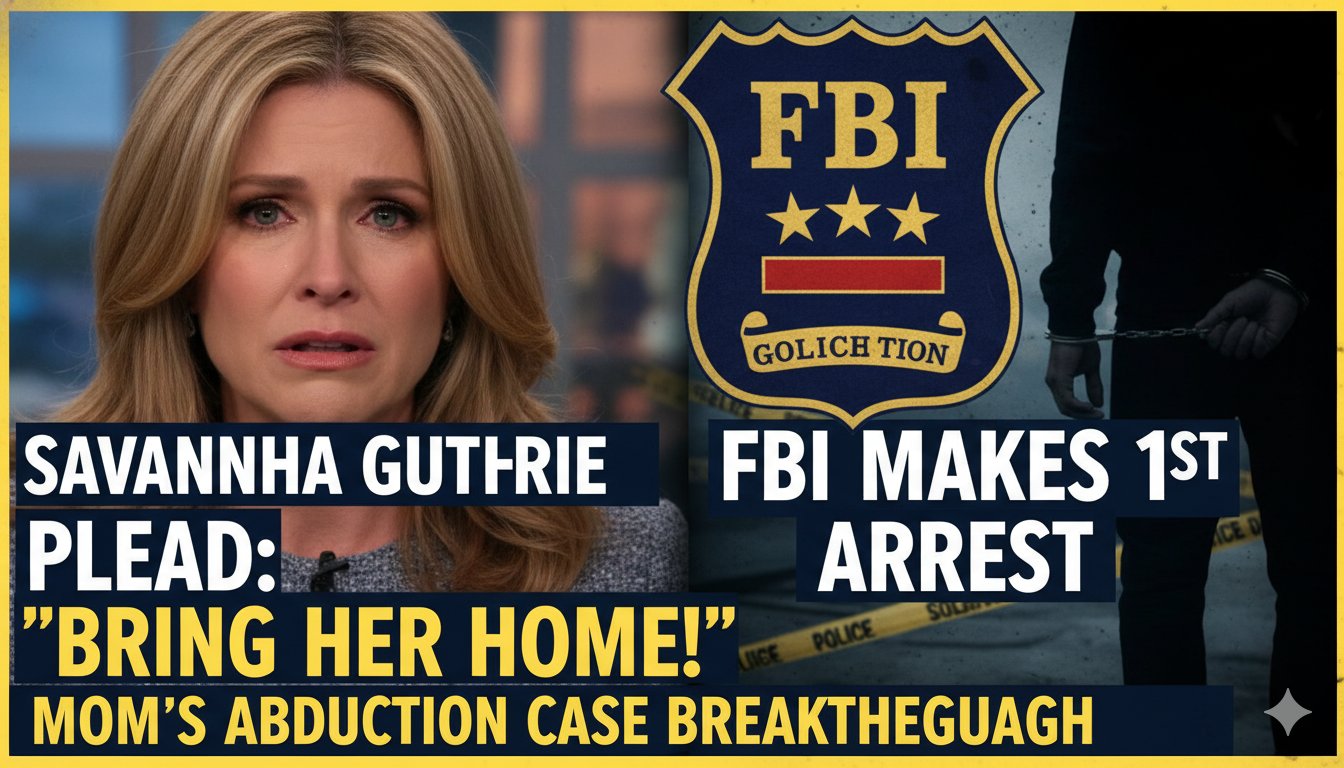
“The FBI has made its first arrest in connection with the abduction of Nancy Guthrie, the 84-year-old mother of ‘Today’ host Savannah Guthrie, involving a California man accused of sending a fake ransom demand for bitcoin as the search enters its sixth day with no suspects in the actual kidnapping; family members, including Savannah, have issued emotional pleas for her safe return amid investigations into a separate ransom note demanding millions in cryptocurrency.”
The investigation into the disappearance of Nancy Guthrie, the elderly mother of prominent NBC anchor Savannah Guthrie, has taken a significant turn with federal authorities announcing the first arrest linked to the case. A man from Southern California, identified as Derrick Callella, faces charges for allegedly attempting to extort the Guthrie family by sending fraudulent ransom demands via text messages, requesting payments in bitcoin. This development comes as the search for the missing 84-year-old intensifies, with no leads yet on her actual abductors despite signs of a violent struggle at her Tucson, Arizona, home.
Federal prosecutors charged Callella with intent to transmit a demand for ransom and using a telecommunications device to anonymously abuse, threaten, or harass a person. He is expected to appear in federal court in Los Angeles, marking a swift response to what officials described as an “imposter” scheme exploiting the high-profile nature of the abduction. While this arrest addresses opportunistic fraud, it underscores the challenges law enforcement faces in separating legitimate threats from hoaxes in a case that has captured national attention.
The abduction itself unfolded under mysterious circumstances. Nancy Guthrie vanished from her residence in a quiet neighborhood near Tucson sometime between late January 31 and early February 1. Authorities arrived at the scene after a welfare check prompted by concerned family members who couldn’t reach her. Inside the home, investigators discovered evidence of foul play, including blood stains on the porch that forensic tests confirmed match Nancy’s DNA profile. Additional traces suggested a struggle, with items displaced and possible defensive wounds implied by the blood patterns.
Security footage from the property revealed limited insights, as outdoor floodlights appeared to have been tampered with—one bulb deliberately removed, potentially to obscure the perpetrator’s actions. This detail has fueled speculation among experts that the kidnappers possessed prior knowledge of the home’s layout and security measures, pointing to a targeted operation rather than a random crime. Former FBI agents have suggested the possibility of an insider connection or reconnaissance, noting that the abductors seemed to bypass standard safeguards with ease.
Complicating the probe is a ransom note sent to entertainment outlet TMZ and two local Tucson television stations shortly after Nancy’s disappearance was reported. The note, which authorities are treating as potentially authentic, demanded millions of dollars in bitcoin—a cryptocurrency favored by criminals for its perceived anonymity. It included specific details about the abduction, such as references to the tampered floodlight, which lent credibility to the claim. The demand outlined two deadlines: the first, set for 5 p.m. on February 5, has already passed without apparent compliance or further communication from the purported kidnappers. The second deadline looms on February 9, heightening urgency for negotiators.
In response, the FBI has deployed hostage negotiation teams to assist the family, working alongside the Pima County Sheriff’s Department. A tip line has been established at 1-800-CALL-FBI, and a reward of up to $50,000 is being offered for information leading to Nancy’s recovery or the arrest of those responsible. Crime scene tape was reinstated at the Guthrie home as recently as February 5, indicating ongoing forensic sweeps for additional evidence, including potential DNA from suspects.
The Guthrie family’s public appeals have added an emotional layer to the unfolding drama. Savannah Guthrie, known for her composed presence on the “Today” show, broke from her usual demeanor in a tearful video message, directly addressing the kidnappers with a plea: “Please, bring her home.” Her brother echoed this sentiment in a separate statement, urging any captors to make direct contact and emphasizing the family’s willingness to negotiate. These pleas highlight the personal toll of the ordeal, as Nancy requires daily medication for health conditions, raising fears that her well-being could deteriorate rapidly without proper care.
Theories surrounding the motive abound, with some experts positing that the kidnappers may have targeted Nancy due to her daughter’s celebrity status. Proud of her children’s achievements, Nancy reportedly shared stories about Savannah during routine interactions, such as rides with Uber drivers—one of whom was interviewed early in the investigation after transporting her to a family member’s home just days prior. This openness could have inadvertently provided opportunists with details about her routine and vulnerabilities.
Another chilling hypothesis floated by former law enforcement officials involves cross-border elements. Given Tucson’s proximity to the U.S.-Mexico border—less than 60 miles away—analysts suggest Nancy may have been transported south, where jurisdictional complexities could hinder recovery efforts. This theory aligns with patterns seen in other high-profile abductions, where perpetrators seek to exploit international boundaries for leverage.
The use of bitcoin in the ransom demand introduces a financial dimension to the case, reflecting a growing trend in criminal enterprises. Bitcoin’s decentralized nature makes tracing transactions challenging, though blockchain analysis tools employed by the FBI have led to breakthroughs in similar cases. The demanded sum, reportedly in the millions, would require sophisticated wallet setups to avoid detection, but experts note that errors in handling cryptocurrency often provide investigative leads.
As the search enters its seventh day, community response in Tucson has been profound. Neighbors described Nancy as a vibrant, independent woman who enjoyed gardening and local events, leaving the area stunned by the audacity of the crime. Vigils and social media campaigns have amplified calls for information, with hashtags circulating widely to keep the case in the public eye.
Law enforcement briefings continue to emphasize the need for public vigilance. During a February 5 press conference, FBI Phoenix Special Agent in Charge Heith Janke stressed that while the imposter arrest is a step forward, the primary focus remains on locating Nancy alive. “We are pursuing every lead aggressively,” Janke stated, underscoring the joint efforts between federal, state, and local agencies.
The case has drawn commentary from national figures, including President Trump, who called it a “very unusual situation” and pledged federal resources to resolve it swiftly. This high-level attention may accelerate investigative tools, such as advanced surveillance analysis and inter-agency data sharing.
Potential breakthroughs could come from digital forensics, as investigators scour Nancy’s phone records, email, and online activity for anomalies. The family’s cooperation has been instrumental, providing timelines and contacts that help reconstruct the hours leading to her disappearance.
In the broader context of missing persons cases, this incident highlights disparities in resource allocation. While Nancy’s connection to a media personality has mobilized extensive efforts, advocates point out that thousands of everyday abductions receive far less attention, prompting calls for systemic reforms.
As deadlines approach and leads are chased, the nation watches closely, hoping for a resolution that reunites the Guthrie family.
Key Developments in the Nancy Guthrie Abduction Case
Timeline of Events : Disappearance reported early February 1; initial welfare check reveals blood and struggle signs; ransom note emerges February 3; first deadline passes February 5; imposter arrest announced February 5; second deadline set for February 9.
Evidence Collected : DNA-matched blood on porch; tampered floodlights; possible additional DNA from suspects under analysis.
Family Response : Emotional pleas from Savannah and siblings; direct appeals to kidnappers for communication.
Law Enforcement Actions : FBI hostage negotiators deployed; $50,000 reward offered; tip line active; crime scene reprocessed.
Suspect Profile : No persons of interest in actual abduction; California man arrested for unrelated fraud.
Theories : Targeted due to family fame; possible Mexico transport; insider knowledge of home security.
Financial Angles of the Ransom
| Aspect | Details | Implications |
|---|---|---|
| Ransom Demand | Millions in bitcoin; two deadlines; specific crime details included | Suggests authentic knowledge; cryptocurrency tracking possible but complex |
| Security Breach | Floodlight bulb removed; no forced entry evident | Indicates premeditation and reconnaissance |
| Health Concerns | Nancy requires medication; age 84 | Time-sensitive urgency for recovery |
| Investigative Resources | Joint FBI-local effort; negotiators; forensics | High-profile status accelerates response |
| Public Involvement | Tip line; reward; social media campaigns | Potential for crowd-sourced leads |
The demand for bitcoin payment aligns with a surge in cryptocurrency-related crimes, where digital assets offer pseudo-anonymity. Current bitcoin value hovers around $45,000 per coin, meaning a multi-million demand could involve dozens of units. Law enforcement’s blockchain experts are likely monitoring wallets for transfers, a tactic that has unraveled similar schemes in the past.
Expert Insights
Former FBI agents emphasize the rarity of successful long-term abductions for ransom in the U.S., citing improved surveillance and rapid response protocols. However, the border proximity adds a layer of risk, as cartels have been linked to such operations in the past.
Community Impact
Tucson’s residents report increased security measures, with neighborhood watches forming and home alarm sales spiking. The case serves as a stark reminder of vulnerabilities even in serene suburbs.
Ongoing Challenges
Separating genuine tips from misinformation remains a hurdle, especially with the imposter arrest highlighting how publicity attracts fraudsters. Authorities urge the public to report directly to official channels rather than media outlets.
Disclaimer: This news report is for informational purposes only and does not constitute legal, financial, or professional advice. Sources are not endorsed or verified beyond standard journalistic practices.