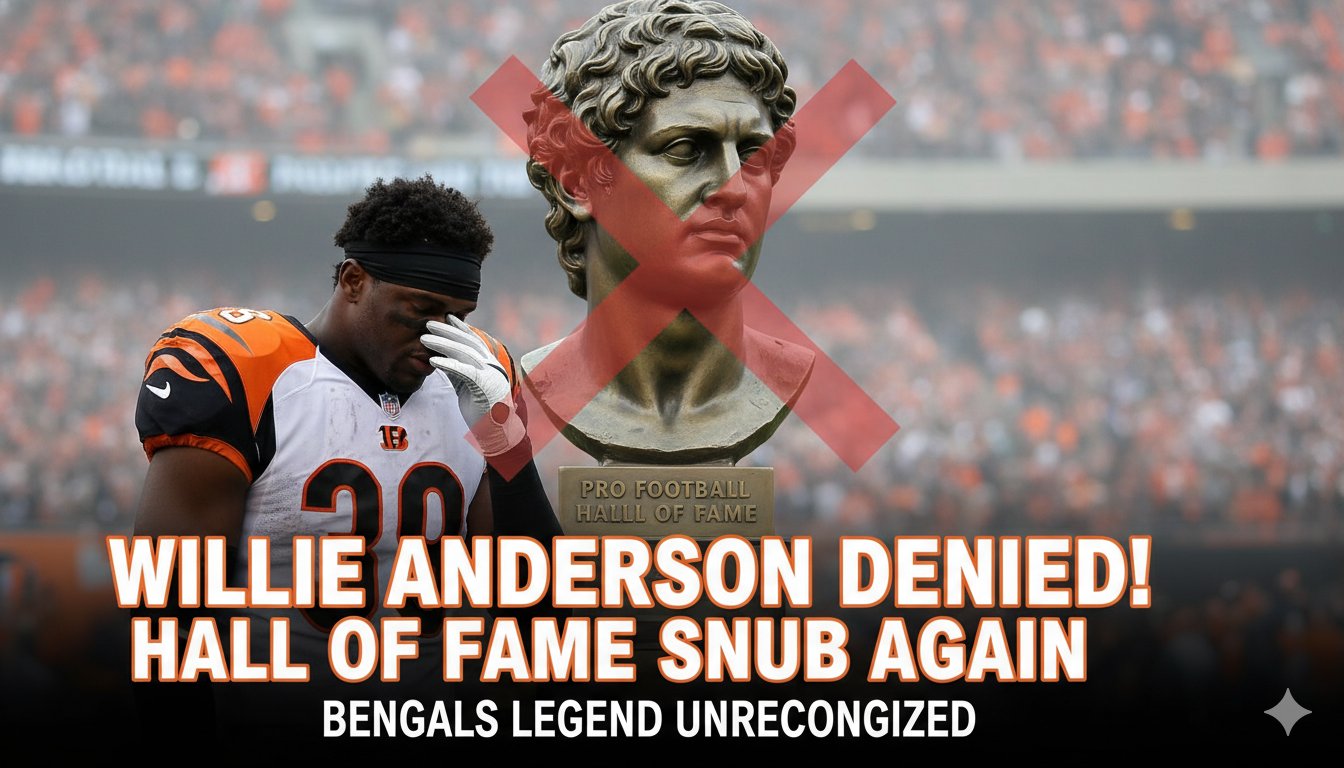
“Former Cincinnati Bengals offensive tackle Willie Anderson, a three-time All-Pro and cornerstone of the team’s line for over a decade, has been denied entry into the Pro Football Hall of Fame for the ninth consecutive year, highlighting ongoing debates about the recognition of elite linemen in the sport.”
Willie Anderson’s exclusion from the Pro Football Hall of Fame continues to spark frustration among fans and analysts alike, as the dominant right tackle who anchored the Bengals’ offensive line from 1996 to 2007 remains on the outside looking in. Selected in the first round of the 1996 NFL Draft out of Auburn University, Anderson quickly established himself as one of the premier pass protectors in the league, earning a reputation for his technique, durability, and ability to neutralize top edge rushers.
Throughout his 12-year career with the Bengals, Anderson started 181 games, missing only two due to injury, a testament to his reliability in an era when offensive linemen faced grueling physical demands. His pass-blocking prowess was instrumental in protecting quarterbacks like Carson Palmer and Jon Kitna, allowing the Bengals’ offense to flourish during a period when the team transitioned from perennial underdogs to playoff contenders. Anderson’s accolades include four Pro Bowl selections from 2003 to 2006 and three consecutive First-Team All-Pro honors from 2004 to 2006, placing him among the elite at his position.
Career Highlights and Statistical Dominance
Anderson’s impact extended beyond individual awards, as he played a pivotal role in the Bengals’ offensive success. In 2005, the team led the NFL in passing yards per game, with Palmer throwing for over 3,800 yards and 32 touchdowns, much of which can be attributed to the stability provided by Anderson on the right side. His run-blocking opened lanes for running backs like Rudi Johnson, who rushed for over 1,300 yards in three straight seasons from 2004 to 2006.
To illustrate Anderson’s excellence, consider his performance metrics compared to other Hall of Fame tackles:
| Player | Years Active | Pro Bowls | All-Pro Selections | Games Started | Sacks Allowed (Career Est.) |
|---|---|---|---|---|---|
| Willie Anderson | 1996-2008 | 4 | 3 | 181 | 38 |
| Anthony Muñoz (HOF) | 1980-1992 | 11 | 9 | 182 | 42 |
| Jonathan Ogden (HOF) | 1996-2007 | 11 | 4 | 176 | 35 |
| Walter Jones (HOF) | 1997-2009 | 9 | 4 | 180 | 23 |
| Joe Thomas (HOF) | 2007-2017 | 10 | 6 | 167 | 30 |
These figures underscore Anderson’s efficiency in pass protection, where he allowed fewer sacks per game than many enshrined peers, despite facing formidable defenses in the AFC North division. His technique, often described as textbook, involved exceptional footwork and hand placement that shut down rushers like Jason Taylor and Dwight Freeney multiple times.
The Long Road to Hall Consideration
Anderson became eligible for the Hall of Fame in 2013, but his journey has been marked by repeated near-misses. He advanced to the semifinalist stage in 2019 and has been a finalist in recent years, including as one of the 15 modern-era finalists for the Class of 2026. The selection process, which involves a committee of 50 voters, requires at least 80% approval for induction, a threshold Anderson has yet to cross.
Critics argue that the Hall’s bias toward skill-position players and those from championship teams has hindered linemen like Anderson. While he never won a Super Bowl, his contributions to the Bengals’ resurgence in the mid-2000s— including a division title in 2005—demonstrate his value in building a competitive squad. Comparisons to inductees like Roger Craig, who benefited from multiple championships with the San Francisco 49ers, highlight how team success can overshadow individual brilliance.
This Year’s Class and the Snub’s Implications
The Class of 2026 features notable names such as quarterback Drew Brees, wide receiver Larry Fitzgerald, linebacker Luke Kuechly, kicker Adam Vinatieri, and running back Roger Craig. Brees, a first-ballot inductee, revolutionized the passing game with the New Orleans Saints, amassing over 80,000 passing yards and leading his team to a Super Bowl victory. Fitzgerald’s consistency as a receiver, with over 1,400 receptions, made him an obvious choice. Kuechly’s short but dominant career included seven Pro Bowls and a Defensive Player of the Year award, while Vinatieri’s clutch kicking in multiple Super Bowls solidified his legacy. Craig, a versatile back from the 1980s 49ers dynasty, finally broke through after years of waiting.
Anderson’s omission stands out, especially given his finalist status alongside players like Torry Holt and Eli Manning, who also missed the cut. Bengals fans and former teammates have voiced disappointment, emphasizing how Anderson’s role in protecting Palmer during his prime years enabled explosive offenses. The snub raises questions about the valuation of right tackles versus left tackles, as left-side protectors like Anthony Muñoz (Anderson’s Bengals predecessor) often receive quicker recognition.
Key Points of Contention in Anderson’s Case
Durability and Consistency : Anderson’s streak of 116 consecutive starts from 1999 to 2006 ranks among the longest for offensive linemen, showcasing his resilience in a position prone to injury.
Peer Recognition : Hall of Famers like Bruce Matthews and coaches like Bill Parcells have publicly endorsed Anderson, citing his dominance in one-on-one matchups.
Divisional Challenges : Playing in the rugged AFC North against teams like the Pittsburgh Steelers and Baltimore Ravens, Anderson faced Hall-caliber pass rushers weekly, yet maintained elite performance levels.
Off-Field Impact : Beyond stats, Anderson mentored younger linemen and contributed to community initiatives in Cincinnati, embodying the character aspect valued by the Hall.
The ongoing debate surrounding Anderson’s candidacy has fueled discussions about reforming the selection process, potentially expanding the annual class size or creating categories for underrepresented positions. Former Bengals players like Chad Johnson have highlighted Anderson’s influence, noting how his protection allowed receivers to thrive.
Reactions from the Bengals Community
Within the Bengals organization and fanbase, Anderson’s repeated denials have become a rallying point. Current head coach Zac Taylor has praised Anderson’s legacy, drawing parallels to the team’s recent offensive line investments. Alumni associations have campaigned for his induction, gathering petitions and testimonials from across the NFL. The sentiment is that Anderson’s exclusion diminishes the Hall’s credibility, as it overlooks players who excelled without the spotlight of championships.
As the Bengals continue to build on their recent Super Bowl appearances, Anderson’s story serves as a reminder of the franchise’s historical figures who laid the groundwork. His career earnings, estimated at over $40 million, reflect his value during his playing days, but the intangible prestige of a gold jacket remains elusive.
Potential Path Forward
Anderson remains eligible for future classes, with his case strengthening as more voters recognize the importance of linemen in modern analytics. Metrics like pass-block win rate, where Anderson would rank highly if retroactively applied, could bolster arguments. Until then, his legacy endures through Bengals lore, where he’s remembered as a quiet giant who dominated the trenches.
Disclaimer: This news report is for informational purposes only and does not constitute professional advice, tips, or endorsements from any sources.