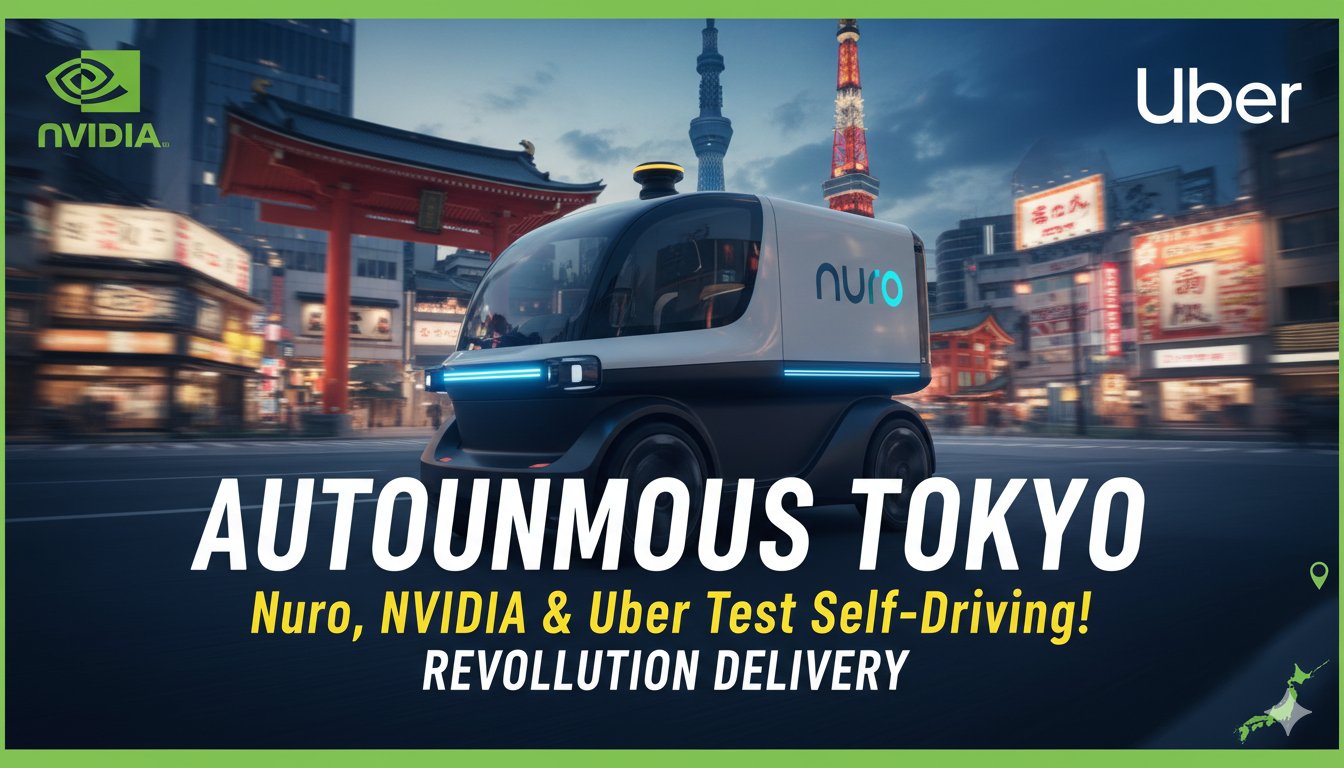
Nuro, the NVIDIA- and Uber-backed autonomous vehicle startup, has launched public road testing in Tokyo using modified Toyota Prius vehicles equipped with its self-driving software. This marks the company’s first deployment outside the United States, featuring “zero-shot” autonomy that operates without prior training on Japanese-specific data. Safety operators remain onboard as testing begins on Tokyo’s dense urban roads, highlighting Nuro’s push toward geography-agnostic AI amid growing global competition in robotaxis and delivery. The move aligns with Nuro’s broader strategy, including its high-profile partnership with Uber and Lucid for premium robotaxi services.
Nuro Advances Global Ambitions with Tokyo Testing
Nuro has taken a significant step forward in its international expansion by deploying a handful of test vehicles on public roads in Tokyo. The vehicles, modified Toyota Prius models outfitted with Nuro’s advanced autonomous driving stack, began operations last month with human safety operators behind the wheel to comply with local regulations and ensure oversight during initial trials.
This deployment represents Nuro’s inaugural foray beyond U.S. borders, following its strategic pivot toward licensing its self-driving technology to automakers and mobility providers. The company established a local presence in Tokyo by opening offices, securing necessary facilities, and assembling teams to support operations and data collection efforts.
A standout aspect of the Tokyo initiative is Nuro’s demonstration of “zero-shot” autonomy. The system relies on a universal model trained primarily on diverse global driving scenarios rather than location-specific datasets. This approach allows the AI to adapt to entirely new environments, including Japan’s left-hand traffic rules, narrow streets, dense pedestrian zones, and unique driving behaviors without retraining from scratch.
Prior to public road activation, the technology underwent rigorous validation through closed-course testing in Las Vegas, extensive large-scale simulations, and shadow mode runs where the AI processed real-world inputs and made decisions without vehicle control. These preparatory steps built confidence in the system’s robustness across varied conditions.
Tokyo’s urban landscape presents a formidable challenge, often described as a high-stakes pressure test for autonomous systems. The city’s complex traffic patterns, frequent intersections, unpredictable pedestrian movements, and compact road layouts demand exceptional perception, prediction, and decision-making capabilities. Nuro’s ability to deploy here underscores progress toward scalable, adaptable autonomy that could reduce development costs and accelerate rollout in diverse markets worldwide.
The testing aligns closely with Nuro’s ecosystem partnerships. Backed by NVIDIA’s powerful computing platforms, including DRIVE AGX technologies that enable real-time AI processing, the stack benefits from high-performance hardware optimized for autonomous applications. Uber’s involvement further ties into Nuro’s trajectory, as the ride-hailing giant has committed substantial resources to autonomous mobility, targeting a large fleet incorporating NVIDIA chips.
Nuro’s collaboration with Uber and Lucid Group focuses on developing a production-intent robotaxi designed exclusively for the Uber platform. This vehicle combines Lucid’s electric architecture with Nuro’s autonomy software, with on-road engineering prototype testing already underway in the San Francisco Bay Area under supervised conditions. The program envisions a premium, rider-focused service launching in a major U.S. city later this year, potentially expanding globally.
In Japan, the regulatory environment remains cautious but increasingly accommodating for autonomous vehicle trials. While full unsupervised operations require additional approvals, the current supervised phase allows valuable real-world data gathering to refine the model. Over time, Nuro plans to integrate Japan-specific observations into its universal framework, enhancing performance and paving the way for future partner deployments.
The Tokyo tests occur against a backdrop of intensifying activity in the Japanese capital. Other players, including partnerships involving Nissan, Uber, and international startups, are preparing robotaxi initiatives for later this year, positioning Tokyo as an emerging hub for autonomous mobility validation.
Nuro’s approach emphasizes licensing its technology stack to partners rather than operating consumer-facing services directly in every market. This model enables faster scaling by leveraging established automakers’ manufacturing capabilities and mobility providers’ distribution networks.
Key advantages of the zero-shot capability include reduced reliance on massive location-specific datasets, which can be resource-intensive to collect, and greater flexibility for entering new regions. Success in Tokyo could validate the viability of this strategy, potentially influencing industry standards for cross-border autonomy development.
As testing progresses, Nuro will monitor performance metrics closely, incorporating feedback to iterate on the system. The company has indicated plans for broader expansions, suggesting Tokyo serves as an early proof point in a larger global rollout.
This development reinforces Nuro’s position among leading autonomous vehicle firms, competing directly with established operators in the push toward commercialized, fully driverless transportation and logistics solutions.
Disclaimer: This is a news report based on publicly available information about developments in autonomous vehicle technology. It is for informational purposes only and does not constitute investment advice, endorsement, or recommendation.