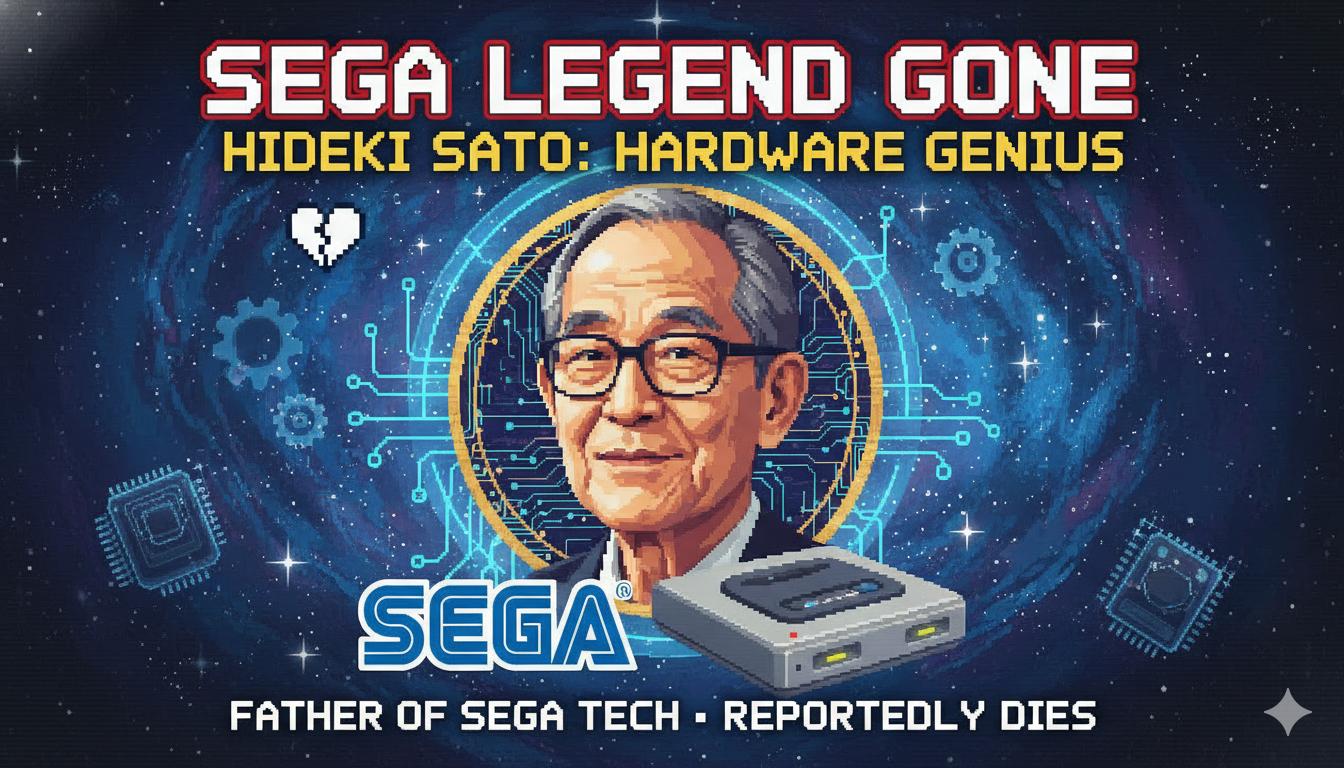
Hideki Sato, the legendary engineer who spearheaded the design of Sega’s iconic home consoles from the SG-1000 through the Dreamcast, and later served as the company’s president, has died at 77. His work defined an era of innovative hardware that challenged industry giants and created lasting cultural impact for generations of gamers. Sato’s contributions spanned over three decades at Sega, shaping arcade-to-console transitions, fierce market rivalries, and groundbreaking systems that remain beloved today.
Hideki Sato: Architect of Sega’s Golden Era
Hideki Sato joined Sega in 1971, a time when the company was primarily focused on arcade machines and importing coin-operated games. Over the next three decades, he rose through the ranks to become one of the most influential figures in the company’s history. His engineering expertise bridged the gap between arcade expertise and the emerging home console market.
Sato played a pivotal role in Sega’s early home hardware efforts. The SG-1000, released in 1983, marked Sega’s first major step into the domestic Japanese market as a direct response to competitors like Nintendo’s Famicom. Though it faced challenges in sales, it laid foundational groundwork for what would follow. Sato’s team refined this approach with the Master System in 1985, which gained stronger traction internationally, particularly in Europe and Brazil, where it enjoyed prolonged success against Nintendo’s dominance.
The breakthrough came with the Mega Drive, known as the Genesis in North America, launched in 1988 in Japan and 1989 in the U.S. Sato led the hardware development as director of Sega’s Research and Development department starting in 1989. The Genesis represented a bold leap: a 16-bit system that emphasized speed, superior arcade ports, and a “cool” brand image targeted at older teens and young adults. Marketing slogans like “Genesis does what Nintendon’t” captured the competitive spirit Sato helped foster. The console sold tens of millions worldwide and hosted timeless titles such as Sonic the Hedgehog, which became Sega’s flagship mascot and a defining force in the early 1990s console wars.
Sato’s influence extended to the Sega Saturn, released in 1994 in Japan and 1995 in the West. Designed as a powerful 2D/3D hybrid with dual processors, the Saturn aimed to dominate both arcade-perfect ports and emerging 3D gaming. While it struggled commercially due to complex architecture, high price, and launch missteps, Sato’s engineering vision pushed boundaries in polygon rendering and CD-based storage at a time when the industry was shifting rapidly.
The pinnacle of Sato’s hardware legacy arrived with the Dreamcast in 1998 (Japan) and 1999 (North America). As Sega’s final home console, the Dreamcast introduced built-in modem connectivity for online play, a built-in VMU memory card with its own screen, and a powerful architecture that delivered smooth 3D experiences ahead of its time. Games like SoulCalibur, Shenmue, and Crazy Taxi showcased its capabilities, and features like internet browsing and downloadable content foreshadowed modern online ecosystems. Despite strong critical acclaim and innovative design, the Dreamcast faced intense competition and market saturation, leading Sega to exit the hardware business in 2001.
Following the departure of key leadership, Sato stepped into the role of Sega president from 2001 to 2003. During this transitional period, he oversaw the company’s shift from hardware manufacturing to a third-party software publisher. This strategic pivot allowed Sega to thrive by bringing franchises like Sonic, Yakuza, and Persona to multiple platforms, ensuring long-term survival and relevance in an evolving industry.
Throughout his career, Sato emphasized innovation under pressure. In interviews reflecting on Sega’s history, he described the early console push as moving from arcade familiarity to uncharted territory, driven by unexpected success and ambition. His teams consistently aimed to differentiate through performance, unique features, and bold risks—qualities that defined Sega’s identity as the “rebel” challenger.
Sato retired fully from Sega around 2008 after more than 35 years of service. His passing marks the end of an era for one of gaming’s most storied companies. Fans and industry veterans continue to celebrate the consoles he helped create, which shaped childhoods, sparked rivalries, and influenced hardware design philosophies for decades.
Key Sega Consoles Led by Hideki Sato
SG-1000 (1983) — Sega’s debut home console, introducing cartridge-based gaming to the domestic market.
Master System (1985) — Enhanced successor with better graphics and international appeal.
Mega Drive/Genesis (1988/1989) — 16-bit powerhouse that challenged Nintendo and popularized Sonic.
Sega Saturn (1994/1995) — Advanced dual-CPU system focused on 2D excellence and arcade transitions.
Dreamcast (1998/1999) — Forward-thinking platform with online capabilities and innovative peripherals.
Sato’s engineering leadership not only built hardware but also built a passionate fanbase that endures today, keeping Sega’s classic era alive through emulation, collections, and remakes.
Disclaimer: This is a news report based on publicly available information. It is not investment advice or a solicitation to buy or sell securities.