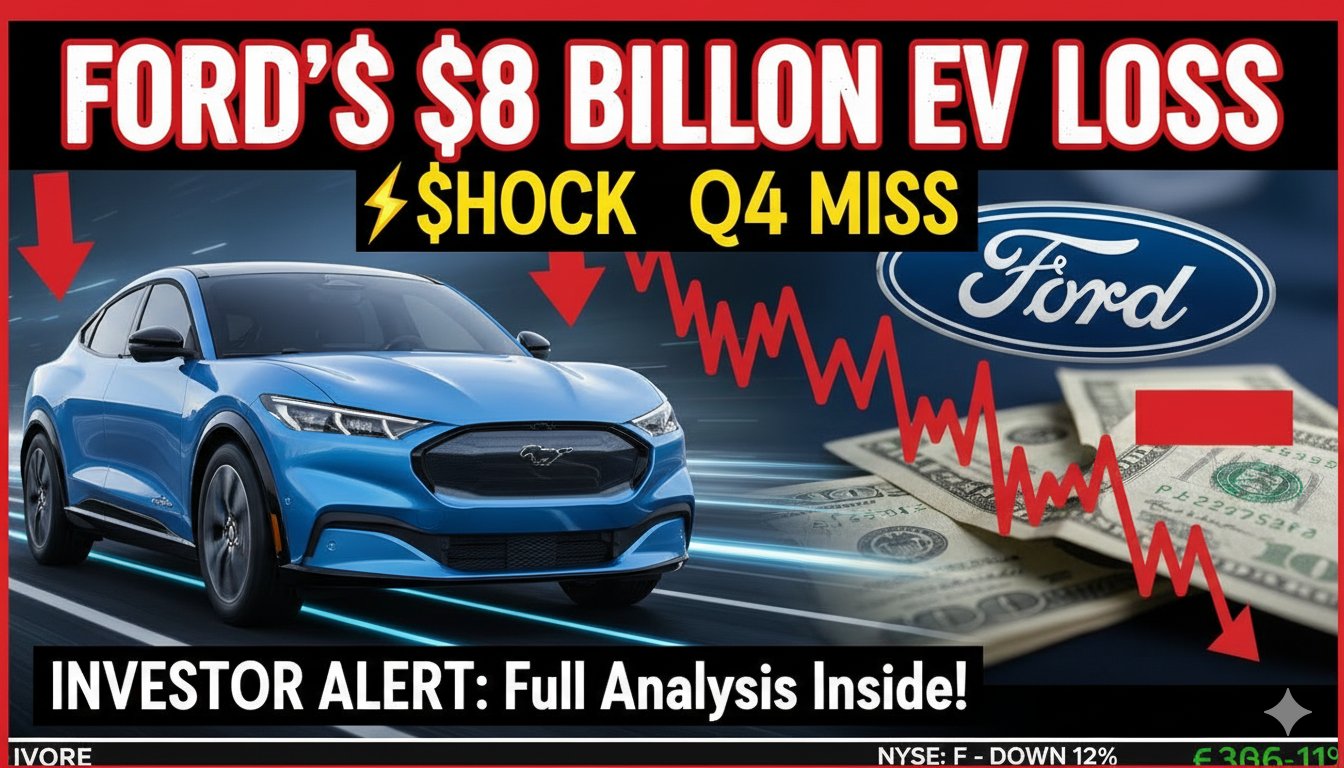
**” Ford Motor Company posted a significant fourth-quarter adjusted earnings shortfall and recorded an $8.2 billion full-year net loss, driven primarily by substantial charges and ongoing losses in its electric vehicle division, Model e. Despite revenue holding steady in some areas, special items including EV program impairments and higher tariff impacts overshadowed core operations, marking one of the company’s weakest financial performances in recent history. Leadership points to a potential rebound in the coming year through cost reductions and stronger contributions from traditional and commercial segments. “**
Ford’s Challenging Fourth Quarter and Full-Year Results
Ford Motor Company released its fourth-quarter and full-year financial results, revealing a notable miss on profit expectations amid persistent pressures from its electric vehicle strategy. The automaker reported adjusted earnings per share of $0.13 for the fourth quarter, falling short of analyst forecasts around $0.19. Adjusted EBIT for the quarter stood at $1 billion, below the anticipated $1.16 billion. Automotive revenue for the period reached $42.4 billion, aligning closely with expectations.
On a reported basis, the fourth quarter delivered a net loss of $11.1 billion, or $2.77 per share, a stark contrast to the prior year’s profitability in the same period. This large loss stemmed largely from special charges totaling around $14.4 billion in the quarter, including major impairments related to EV assets, program cancellations, and joint venture adjustments.
For the full year, Ford’s net loss amounted to $8.2 billion, its most severe annual performance since the 2008 financial crisis. Adjusted EBIT for the year came in at $6.8 billion, near the company’s own guidance of approximately $7 billion but missing Wall Street estimates of $8.86 billion. Adjusted free cash flow landed at $3.5 billion, within the midpoint of prior projections.
The Model e electric vehicle unit remained a primary drag on performance. It posted an EBIT loss of $4.8 billion for the full year, reflecting a slight improvement from the previous year’s deficit but still representing billions in ongoing investments and operational challenges. In the fourth quarter alone, Model e contributed approximately $1.2 billion in losses. Management has indicated that profitability for this segment is not expected until 2029 at the earliest, tied to the rollout of next-generation platforms and partnerships, such as potential collaborations for affordable EVs in key markets.
Traditional segments provided some offset to the EV pressures. The Ford Pro commercial vehicles business delivered strong results, generating significant EBIT with healthy margins around 10%. The Ford Blue unit, encompassing gasoline and hybrid vehicles, also contributed positively, supported by demand for popular models like the F-Series trucks, which continue to anchor profitability.
Additional headwinds included unexpected cost increases from tariffs, which added roughly $2 billion to expenses for the year—higher than initially projected due to policy adjustments late in the period. Supplier disruptions, including a fire at a key aluminum provider, further impacted production efficiency and added to costs.
Looking forward, Ford outlined guidance for the upcoming year projecting adjusted EBIT in the range of $8 billion to $10 billion, representing a meaningful step up from the prior period. Free cash flow is anticipated between $5 billion and $6 billion, with capital expenditures planned at $9.5 billion to $10.5 billion. Segment expectations include continued strength in Ford Pro at $6.5 billion to $7.5 billion in EBIT, Ford Blue at $4 billion to $4.5 billion, and Model e losses narrowing slightly to $4 billion to $4.5 billion.
The results underscore the broader industry transition challenges, where legacy automakers balance heavy EV spending against core internal combustion and hybrid strengths. Ford’s pivot toward more pragmatic EV development, cost discipline, and reliance on proven revenue drivers positions it for potential recovery, though near-term volatility from restructuring charges and external factors remains.
Key Financial Highlights
Q4 Adjusted EPS : $0.13 (miss vs. ~$0.19 expected)
Q4 Adjusted EBIT : $1 billion
Q4 Net Loss : $11.1 billion
Full-Year Adjusted EBIT : $6.8 billion
Full-Year Net Loss : $8.2 billion
Model e Full-Year EBIT Loss : $4.8 billion
Adjusted Free Cash Flow (Full Year) : $3.5 billion
Segment Performance Overview
Ford Pro (Commercial): Strong margins and EBIT contribution
Ford Blue (Gas/Hybrid): Positive profitability amid steady demand
Model e (EV): Continued losses but targeted improvements ahead
Disclaimer : This is a news report based on publicly available financial data and company statements.