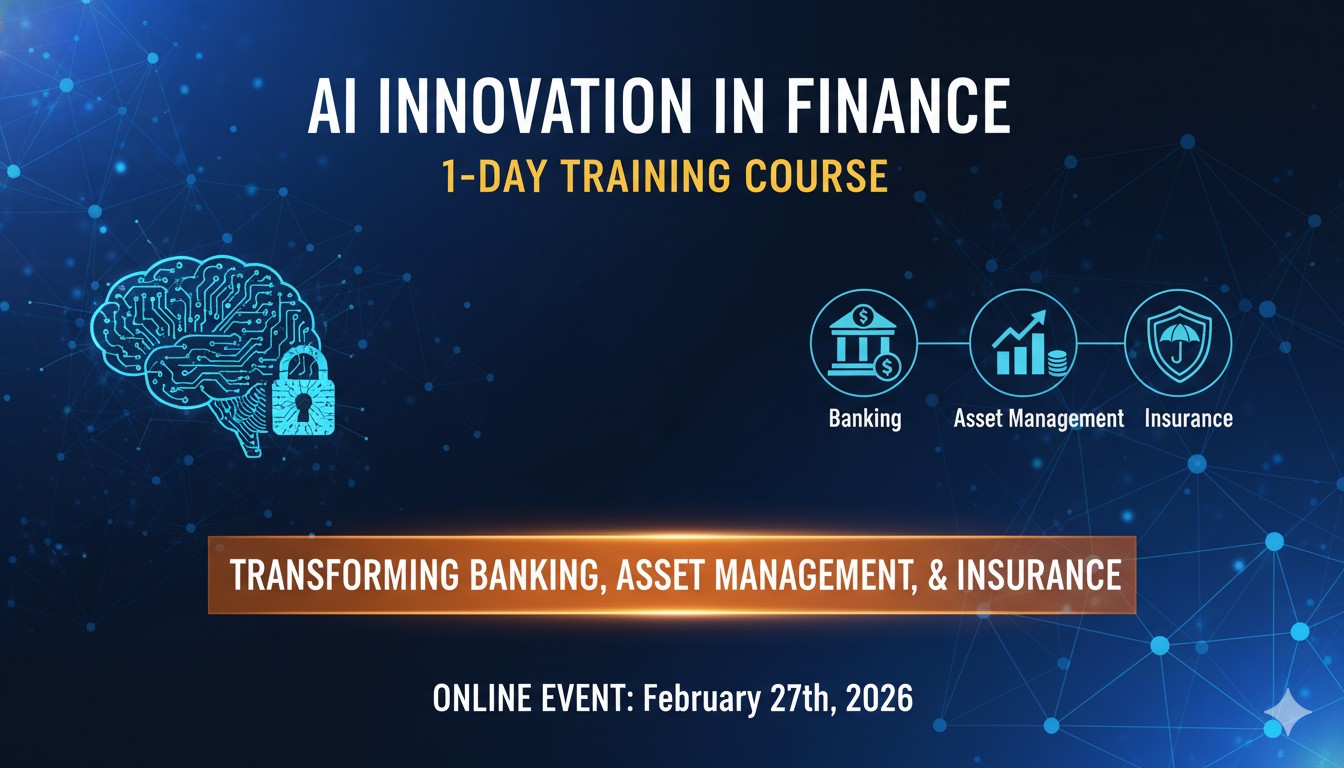
“A comprehensive one-day online workshop equips finance professionals with essential knowledge of artificial intelligence’s evolution and its profound applications in banking, asset management, and insurance. Led by a senior FinTech expert, the session covers AI fundamentals, cutting-edge advancements, practical use cases for efficiency gains, risk mitigation, personalized services, and new revenue opportunities, preparing participants to drive innovation in their organizations amid rapid sector transformation.”
Detailed Course Overview and Industry Impact
The financial services landscape in 2026 stands at a pivotal juncture, where artificial intelligence has transitioned from experimental pilots to core operational drivers. This intensive one-day online training course, scheduled for February 27th, 2026, delivers targeted insights into how AI reshapes banking, asset management, and insurance. Designed for professionals seeking actionable understanding without multi-week commitments, the program explores AI’s historical context, recent breakthroughs, and sector-specific deployments that enhance decision-making, customer engagement, and profitability.
The course begins with foundational elements, tracing AI’s progression from early machine learning models to today’s generative and agentic systems. Participants examine how large language models and autonomous agents process vast datasets in real time, enabling predictive capabilities far beyond traditional analytics. Emphasis falls on practical implications: AI’s ability to analyze unstructured data at scale, generate insights from complex financial narratives, and automate workflows that once required extensive human intervention.
AI’s Transformative Role in Banking
In retail and commercial banking, AI powers hyper-personalized customer experiences while strengthening security protocols. Chatbots and virtual assistants, now evolved into agentic systems, handle complex inquiries, offer tailored product recommendations, and execute transactions seamlessly across channels. Fraud detection benefits from anomaly detection algorithms that monitor behavioral patterns in milliseconds, reducing false positives and catching sophisticated threats.
Credit underwriting processes leverage machine learning to assess risk more accurately by incorporating alternative data sources, including transaction histories and digital footprints. This results in faster approvals, lower default rates, and expanded access for underserved segments. Operational efficiency improves through robotic process automation enhanced by generative AI, which summarizes regulatory documents, generates compliance reports, and streamlines back-office functions. Leading institutions report productivity increases of up to 35% in front-office roles, with broader adoption expected to contribute hundreds of billions in annual value industry-wide.
Revolutionizing Asset Management
Asset managers increasingly integrate AI into investment workflows to gain competitive edges in a crowded market. Predictive modeling identifies emerging trends and portfolio opportunities by processing market signals, news sentiment, and macroeconomic indicators. Generative AI assists in research by synthesizing vast reports into concise summaries, enabling analysts to focus on high-value strategy formulation.
Portfolio construction benefits from optimization algorithms that balance risk and return while incorporating ESG factors and alternative data. Risk management advances with real-time scenario simulations and stress testing that account for unprecedented events. Front-office applications include AI-driven client profiling and personalized investment recommendations, shifting from standardized advice to dynamic, context-aware guidance. As agentic AI matures, systems autonomously manage routine tasks like rebalancing and reporting, allowing portfolio managers to oversee larger mandates efficiently.
Tokenization of assets emerges as a key theme, with AI facilitating the digitization of traditional holdings into blockchain-based formats for fractional ownership and enhanced liquidity. This opens new avenues for retail investors while providing institutions with diversified exposure.
Driving Innovation in Insurance
The insurance sector harnesses AI to redefine underwriting, claims processing, and customer interactions. Predictive analytics refine risk assessment by analyzing telematics, IoT data, and lifestyle information, enabling usage-based pricing models that reward safer behaviors. In property and casualty lines, computer vision assesses damage from images submitted via mobile apps, accelerating claims settlements.
Fraud prevention relies on network analysis and behavioral modeling to flag suspicious patterns across policies. Customer service improves through AI-powered assistants that provide instant policy explanations and coverage recommendations. Life and health insurers use generative AI for personalized wellness programs and actuarial modeling that incorporates longevity trends.
Overall, AI contributes to lower loss ratios, faster payouts, and innovative products such as parametric insurance triggered by automated data feeds. The technology supports embedded insurance offerings within non-traditional platforms, expanding distribution channels.
Key Benefits and Strategic Considerations
Participants in this training gain clarity on implementation pathways, including data governance requirements, model validation, and regulatory compliance. Discussions address ethical deployment, bias mitigation, and explainability to maintain trust and meet supervisory expectations.
The course highlights measurable outcomes: efficiency ratio improvements of up to 15 percentage points for full AI adopters, enhanced revenue through personalized offerings, and strengthened resilience against emerging risks.
Course Agenda Highlights
AI fundamentals and historical evolution
Generative and agentic AI capabilities
Sector-specific applications in banking, asset management, and insurance
Real-world case studies of successful deployments
Challenges including data quality, talent needs, and regulatory navigation
Future outlook on AI’s role in financial services
This focused session equips attendees to identify high-impact opportunities and contribute to their organizations’ AI strategies effectively.
Disclaimer: This article provides general information and insights on AI developments in financial services for educational purposes only. It does not constitute financial, investment, legal, or professional advice. Readers should consult qualified experts for specific guidance.